UK Greyhound Cards Today — The Complete Punter's Playbook
 Available in US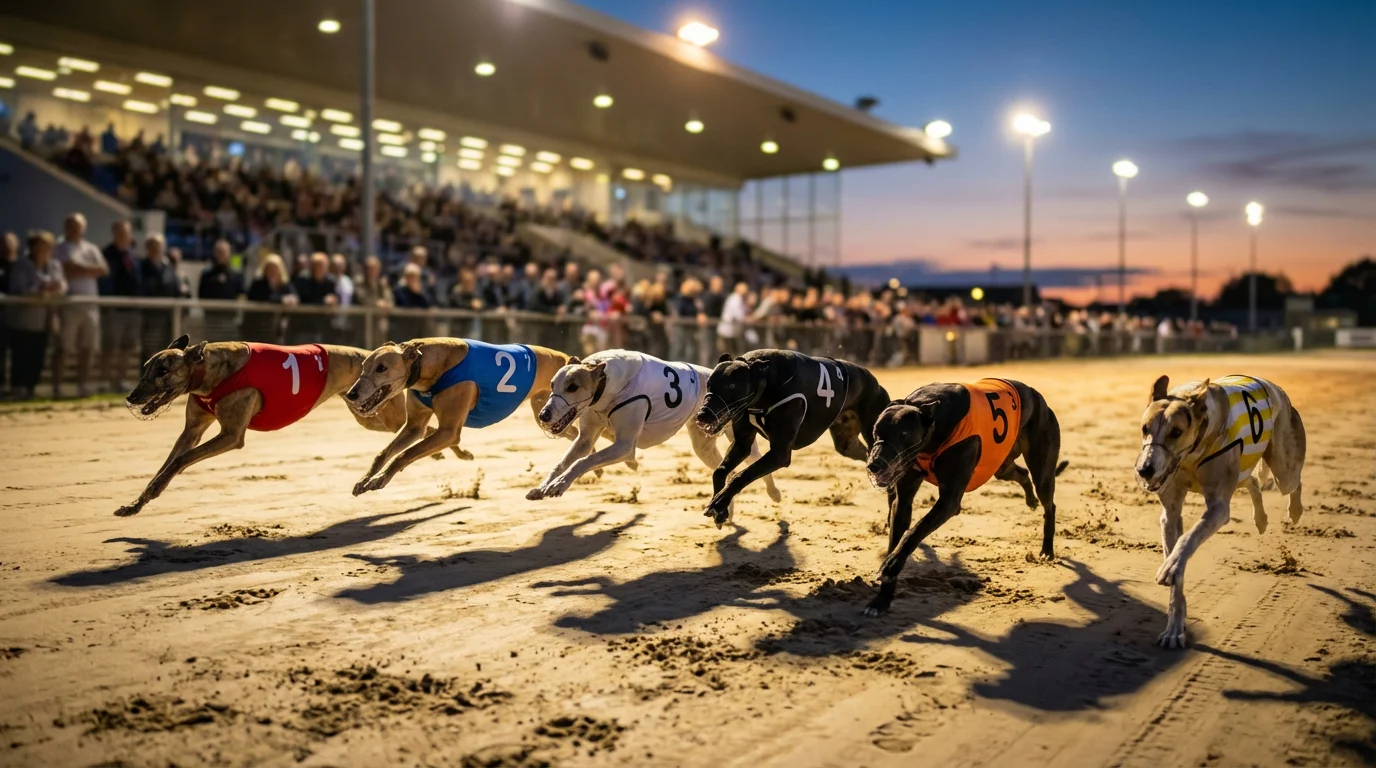
How to read racecards, decode form, and find value on every card — from trap draw to starting price.
Start Reading
What Greyhound Racecards Actually Tell You — And What They Don't
A racecard is a bet before the bet. Every number on it is either a clue or a distraction, and the punter who cannot tell the difference is already losing before the traps open. This is the fundamental skill that separates the casual once-a-week greyhound bettor from the serious student of form: the ability to look at today's card, read the raw data, and extract a view that the bookmaker's price has not fully captured.
If you have arrived at greyhound racing from horse racing, the racecard will look superficially familiar. There are runners, form figures, times, and trainer names. The structure borrows from the same lineage. But the detail is compressed in ways that change the analysis completely. A horse racecard covers twelve or more runners across varied distances, ground conditions, and race types. A greyhound racecard presents six dogs, one distance, one surface, and a race that will be over in less than thirty seconds. That compression is your advantage if you know how to use the card, and your blind spot if you do not.
A UK greyhound racecard — the version you will see on platforms like Timeform, At The Races, or in a bookmaker's app — typically contains the following for each runner: trap number and colour, dog name, sire and dam, age, weight, trainer, the last six runs in form-line format, split times, calculated times, going adjustment, and analyst remarks. Some premium sources add Timeform ratings, track-specific statistics, or trap bias overlays. Free sources give you the skeleton. Paid sources give you the musculature.
🐕 Racecard Decoder
Formanalyse & Value-Check
Eine Rennkarte ist die Wette vor der Wette. Jede Zahl ist entweder ein Hinweis oder eine Ablenkung. Gib die wichtigsten Daten aus der Karte ein – der Rechner zeigt, ob der Hund echte Form hat und ob die Buchmacher-Quote Value bietet.
Vergleiche drei Hunde aus der Rennkarte – der Rechner zeigt, welcher Hund den besten Value bietet.
What the racecard does not tell you is equally important. It does not tell you how the dog looked in the parade ring. It does not reflect a trial run that happened two days ago but has not yet appeared on the form record. It does not account for a last-minute track condition change that favours one running style over another. The racecard is a historical document with predictive power — but it is not a crystal ball, and treating it as one is how punters convince themselves they have done the homework when they have only read the headlines.
UK greyhound racecards also differ from their Irish and Australian counterparts in structure and emphasis. Irish cards, particularly those for meetings at tracks licensed under Rásaíocht Con Éireann (Greyhound Racing Ireland), use a slightly different form-line layout and grading convention. Australian cards lean more heavily on box draw statistics and course-specific ratings. The UK format, governed by GBGB standards, prioritises the six-run form grid, calculated time, and the remarks column — three elements that, properly interpreted, give a comprehensive picture of a dog's current ability relative to the field.
This guide breaks down every element of the UK greyhound racecard, then moves beyond reading to interpretation: how form patterns predict outcomes, how split times reveal hidden edge, and how the trap draw decides more races than most bettors realise. It covers where to find today's best cards, which bet types fit which race scenarios, and what the numbers on the card actually mean for the bet you are about to place.
What is a greyhound racecard?
A greyhound racecard is a pre-race information sheet published for every scheduled meeting at a GBGB-licensed track in the UK. It lists each runner's trap draw, identification details, recent form, timing data, and trainer information. Racecards are published several hours before the meeting and are available online through data providers, bookmaker apps, and track websites. They are the primary analytical tool for any greyhound bettor making informed selections.
Anatomy of a UK Greyhound Racecard
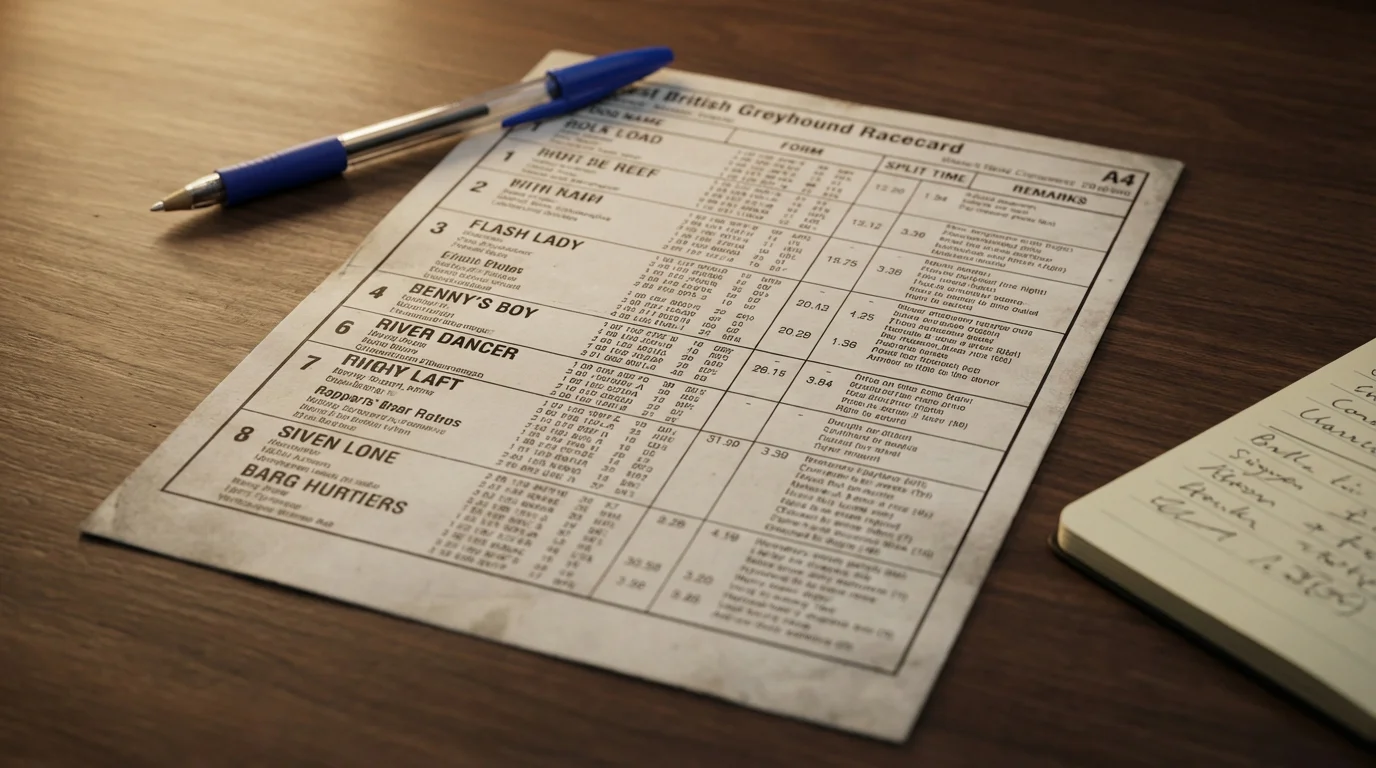
Strip the card to its skeleton and every section does exactly one job. The challenge is not that racecards are complicated — they are dense. A single runner's entry on a UK greyhound racecard packs trap draw, identification, breeding, weight, six runs of form data, timing splits, going adjustments, and remarks into a space smaller than a playing card. Understanding the architecture means you can scan a full six-dog race in under two minutes and know where to look closer.
The racecard is organised into blocks. At the top sits the race header: race number, scheduled time, distance in metres, grade, and prize money. Below it, each of the six runners gets an individual entry. Within each entry, the information flows from identification on the left through form data in the centre to timing and remarks on the right. This layout is consistent across all GBGB-licensed tracks, though the visual presentation varies between data providers.
What the racecard shows
Trap 1 (Red) — Ballymac Swift
Form: 211132
Best time: 29.41
CalcTm: 29.22
Remarks: EP, RnOn, Led2
What it actually means
Inside draw, seeded as a railer — short run to first bend.
Consistently competitive: won 2 of last 6, never worse than 3rd.
Raw time set on fast going — may not reflect current ability.
Adjusted for conditions — this is the real speed comparison figure.
Shows early pace, stays on, led at the second bend — a front-runner.
Trap Number, Colour and Seeding
Every greyhound in a UK race is assigned one of six traps, numbered 1 through 6 from inside to outside. Each trap has a permanent colour: trap 1 is red, trap 2 is blue, trap 3 is white, trap 4 is black, trap 5 is orange, and trap 6 wears black and white stripes. These colours correspond to the racing jacket the dog wears, making identification straightforward during live viewing or streaming.
In graded races, trap allocation is not random. The racing manager at each track seeds dogs according to their running style. Dogs classified as railers — those that prefer to run close to the inside rail — are typically drawn in traps 1 and 2. Middle runners go into traps 3 and 4. Wide runners, comfortable taking the outer path around bends, are placed in traps 5 and 6. This seeding is designed to reduce crowding at the first bend and produce cleaner racing, but it also creates predictable patterns that informed punters can exploit.
Open races are the exception. In open-class events, the trap draw is random, which means a confirmed railer might land in trap 6 and a wide runner in trap 1. This randomness is what makes open races both the most exciting and the most treacherous betting propositions on the card.
Runner Information: Name, Sire, Dam, Age, Weight
Directly below the trap number, the racecard shows the dog's registered name, followed by its sire and dam in parentheses. Breeding lines matter more in greyhound racing than casual bettors assume. Certain sire lines produce dogs with pronounced early speed, while others are associated with stamina and strong finishing. A dog sired by a known sprint specialist running over a middle-distance trip for the first time is a flag worth noting — its genetics may not suit the task.
Age is expressed in years and months. A two-year-old greyhound is still maturing physically and can improve sharply between runs. A dog aged four or older is typically at peak performance or beginning a natural decline. Puppies on an upward development curve are among the most undervalued runners in graded racing — their recent form may not yet reflect their emerging ability.
Weight is given in kilograms, usually to one decimal place. Significant changes between runs — a kilogram or more — can indicate shifts in fitness, health, or preparation. Sex is abbreviated as D (dog, male) or B (bitch, female). For bitches, the racecard may also indicate season status, since female greyhounds are withdrawn during their season and for a recovery period afterwards. A bitch returning from seasonal absence can be unpredictable in her first race back.
Form Lines and Previous Races
The form grid is the heart of the racecard. It shows the dog's last six races in chronological order, each compressed into a single row of data. A typical form line includes: date of the race, venue code, distance in metres, trap number drawn, split time to the first timing point, bend positions (where the dog was placed at each bend), finishing position, beaten distance, the name of the winner or second-placed dog, remarks abbreviations, and the winning time of the race.
Reading a form line from left to right tells you the story of one race. Reading six form lines from top to bottom tells you the story of the dog. A runner showing finishing positions of 1-1-2-1-3-1 is a dog in outstanding current form. One showing 5-6-4-5-6-6 is either outclassed at the current grade or has a persistent issue that the numbers alone may not reveal — which is where the remarks column earns its keep.
The fastest way to scan form is to look at three things in order: finishing positions, split times, and remarks. Positions tell you competitiveness. Splits tell you early pace. Remarks tell you whether a poor result was the dog's fault or the race's fault. A dog that finished fifth but was recorded as CrdRnUp (crowded on the run-up) may have been the best dog in the race on ability — it simply never got a clear run. That is the kind of detail that changes a selection from a guess to an informed opinion.
The average greyhound racecard packs more data per square inch than a cricket scorecard — six runners, six runs each, twelve columns per run, all on a single screen.
How to Read Greyhound Form Like a Sharpshooter
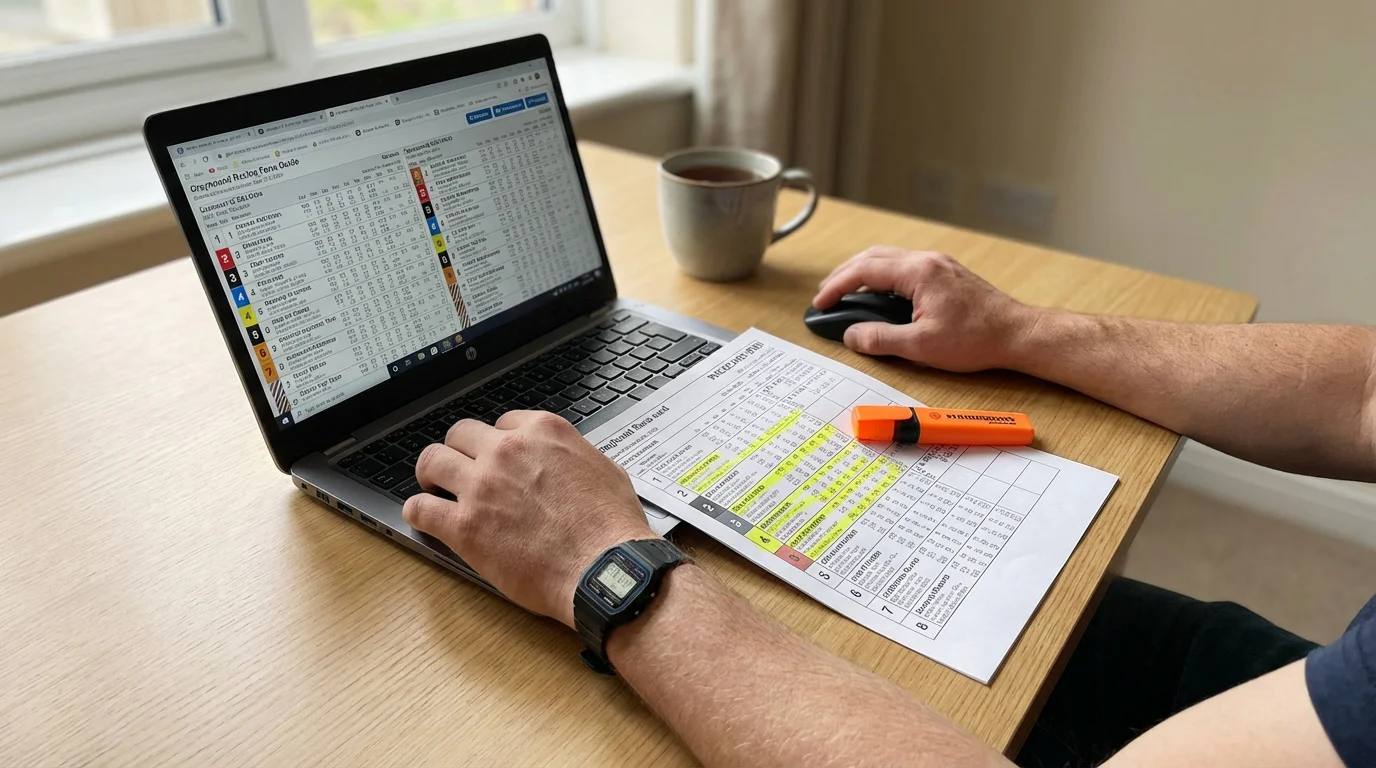
Numbers lie on racecards — patterns do not. The difference between reading form and interpreting form is the difference between seeing data and building an argument. A finishing position of 3 tells you the dog came third. It does not tell you whether the dog was unlucky, outclassed, or ran into traffic at the second bend. Interpretation requires reading form across multiple dimensions simultaneously rather than fixating on any single column.
There are four pillars to greyhound form assessment. Class tells you the standard of opposition. Current form tells you whether the dog is improving, declining, or holding steady. Early speed tells you whether the dog can secure a clean run. The trap draw tells you whether the race's geometry works for or against the dog's natural running style. Skip one and you have a gap in your argument — and gaps are where money disappears.
Class and Grade: The Dog's Level
GBGB-licensed tracks use a grading system that runs from A1 at the top through to lower tiers depending on the track's structure. Some tracks extend to D grades. The principle is straightforward: dogs are graded by performance, and they move up when they win and down when they consistently underperform. The grade of the race on today's card tells you the approximate standard of opposition your selection faces.
A class drop is one of the most significant signals on a racecard. A dog dropping from A2 to A3 may be declining, or it may be a previously competitive runner that had a sequence of bad luck and has been re-graded to a level where it can dominate. Look at the form lines from the higher grade: if the dog was finishing second and third against stronger opposition, the drop might be a gift. If it was finishing fifth and sixth with no excuses in the remarks, the dog may genuinely belong at the lower level.
Comparing times across different grades is one of the most common mistakes casual bettors make. A dog running 29.40 in an A1 race is not necessarily faster than one running 29.60 in A3. The quality of the field, the pace of the race, and whether the dog had a clear run all influence the finishing time. Calculated time, which we will cover shortly, exists precisely to level this playing field.
Current Form: Momentum and Fitness
The last six runs on the form line are not six independent events — they are a trend. Read them as you would a stock chart: is the trajectory up, down, or flat? A dog whose finishing positions read 4-3-2-1-2-1 is improving. One reading 1-2-3-4-4-5 is declining. One reading 2-3-2-3-2-3 is consistent but limited. Each trajectory demands a different betting response.
Improving form is the most attractive profile for a value bet because the market prices dogs on aggregate recent performance, not trajectory. A dog that finished fifth three runs ago and has since posted fourth, third, and second may still be priced as a mid-market runner when it is a dog approaching its peak. The market looks at averages. The sharp punter looks at direction.
Layoffs matter too. A gap of three weeks or more between runs suggests the dog has been resting or recovering. First runs back from a layoff are historically unreliable — the dog may be short of race fitness even if it trialled well. Counting the days between run dates on the form line is a habit worth developing.
Early Speed and Trap Draw Interplay
The split time on the form line records how quickly the dog reached the first timing point from the traps. At most UK tracks, this covers the run from the boxes to roughly the first crossing of the finish line, a distance that encompasses the crucial first bend. A dog with consistently fast splits — anything under 4.00 seconds at a standard 480-metre track — is an early-pace runner. That means it is likely to be at or near the front when the field hits the first bend, and in greyhound racing, the dog that leads at the first bend wins more races than any other position predicts.
This is where trap draw amplifies or neutralises early speed. A fast-splitting railer drawn in trap 1 has the shortest path to the first bend and the inside rail to protect its position. The same dog drawn in trap 5 has to cover more ground and navigate traffic to find the rail. Its split time might be identical, but its race position at the first bend will be materially worse.
Single-seeded runners — dogs whose running style is unique in the race (the only railer, for example) — have a significant edge because they face no direct competition for their preferred racing line. If the card shows one railer in trap 1 and the rest are middle or wide runners, that railer has a clear run to the first bend with no inside pressure. This is one of the most exploitable patterns on any racecard, and it is visible to anyone who reads the seeding designations.
Four-step form assessment
- Check the grade: is the dog rising, dropping, or steady? A drop from higher class with competitive form is a positive signal.
- Read the trend: look at finishing positions left to right. Improving sequence beats a single good run.
- Compare split times: identify the fastest early-pace runner and check whether its trap draw supports a clear run to the first bend.
- Scan the remarks: look for excuses (Crd, Bmp, SAw) that explain poor finishes. A dog with talent and bad luck is a value proposition.
Split Times, Calculated Time and Going Allowance
Forget finishing times — the first four seconds of a greyhound race tell you more than the last twenty. This is not exaggeration. The split time, measured from the moment the traps open to the dog's first crossing of the timing beam, captures the phase of the race that correlates most strongly with final finishing position. A dog that reaches the first bend in front has a statistical advantage that no amount of finishing speed can reliably overcome, particularly at tight-bending tracks where overtaking opportunities are limited.
Split times at UK tracks typically range from around 3.70 seconds for a fast-breaking sprinter on a short-run track to over 4.40 seconds for a slower beginner at a galloping circuit. The absolute number matters less than the comparison within the race. If five dogs in a six-runner field are splitting between 4.10 and 4.30 and one is splitting 3.85, that dog has a pace advantage that translates directly into first-bend position. The racecard shows this data for every recent run, which means you can assess not just whether a dog has early speed, but how consistently it breaks well — because a dog that splits 3.90 one run and 4.20 the next is unreliable at the start, and that unreliability costs races.
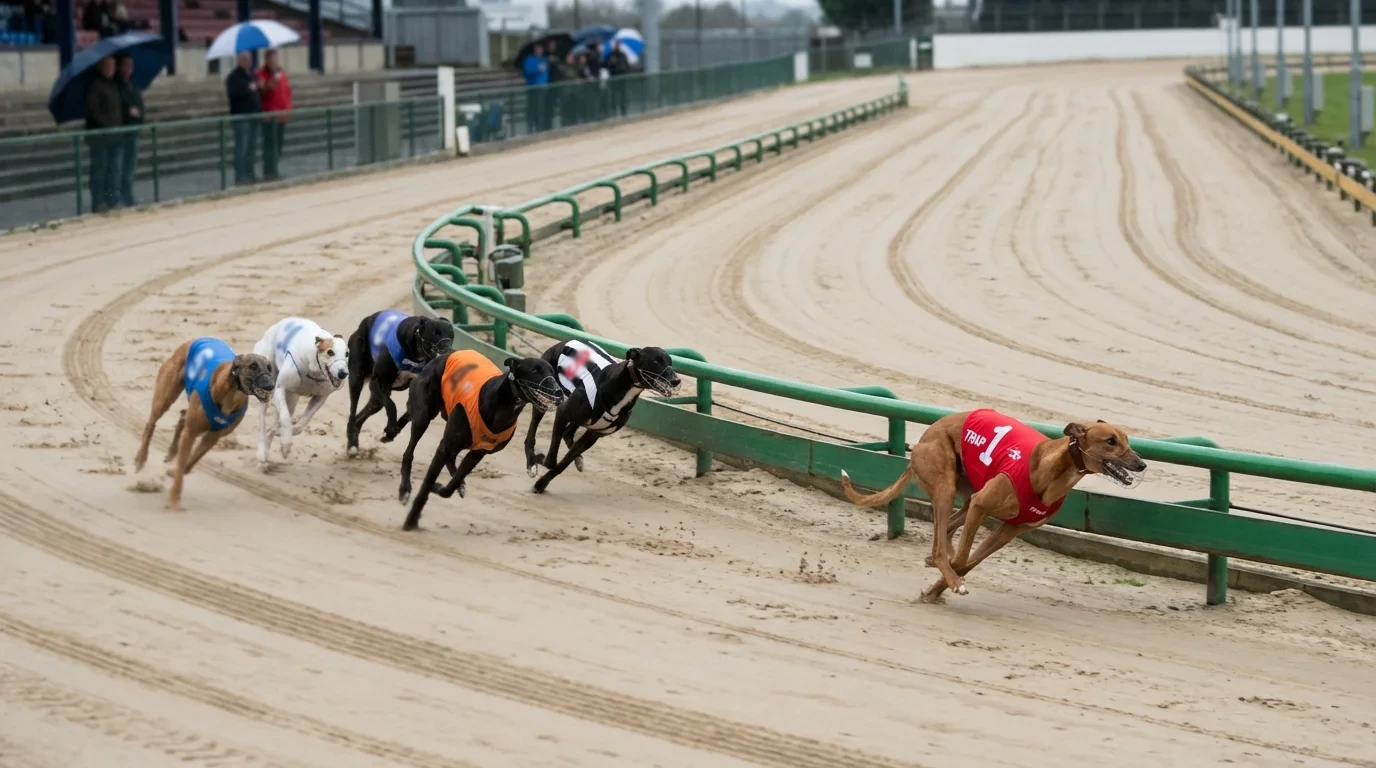
Raw finishing times, by contrast, are misleading without adjustment. A dog recording 29.30 on fast going in midsummer is not necessarily quicker than one recording 29.60 on slow going in February. Track conditions change the surface speed, and without adjusting for this, you are comparing numbers that do not represent the same thing. This is where calculated time becomes essential.
Calculated time — CalcTm on the racecard — takes the dog's raw finishing time and adjusts it by a going allowance: how much faster or slower the track was running compared to standard. Going is expressed as a positive or negative number: +10 means the track was ten spots slow (each spot is 0.01 seconds), -5 means five spots fast, and N means normal conditions.
The calculation is straightforward. If a dog ran 29.60 on a night when the going was +15 (slow), the calculated time is 29.60 minus 0.15 = 29.45. That 29.45 is the time the dog would have run under standard conditions. If another dog ran 29.50 on a night when the going was -10 (fast), its calculated time is 29.50 plus 0.10 = 29.60. The first dog, despite the slower raw time, was running at a higher level once conditions are accounted for. Without CalcTm, you would have picked the wrong dog.
The asterisk convention on some racecards marks a dog's best recent calculated time — often its fastest CalcTm in the last six runs. This is useful as a quick ceiling indicator: it tells you the best this dog has demonstrated under adjusted conditions, which serves as a reference point for whether today's task is within or beyond its established range.
For serious form students, the combination of split time and calculated time creates a two-dimensional profile. Split time tells you where the dog will be at the first bend. CalcTm tells you the overall level of performance, adjusted for conditions. A dog with fast splits and a strong CalcTm is the complete package — early pace and sustained speed. A dog with slow splits but a competitive CalcTm is a closer that may struggle on a tight track but thrive at a galloping circuit where overtaking is possible. The racecard gives you both numbers. The interpretation is yours.
Calculated time comparison: two dogs, different going
Dog A ran 29.58 at Romford. Going on the night: +12 (slow).
CalcTm = 29.58 - 0.12 = 29.46
Dog B ran 29.48 at Romford. Going on the night: -8 (fast).
CalcTm = 29.48 + 0.08 = 29.56
Despite Dog B posting a faster raw time, Dog A's adjusted performance is superior by 0.10 seconds — a meaningful margin in a six-runner field where dogs finish within lengths of each other.
The Trap Draw: Why Draw, Draw, Draw Wins Races
Three things matter at the dogs: draw, draw, and draw. Ask any on-course bookmaker and they will tell you the same. The trap number assigned to a greyhound dictates more about its race outcome than any time figure, any grade classification, or any piece of form data on the card. This is not opinion — it is geometry. Six dogs leave six boxes and converge on one bend. The dog with the clearest path to that bend, combined with the speed to use it, wins more often than any other variable predicts.
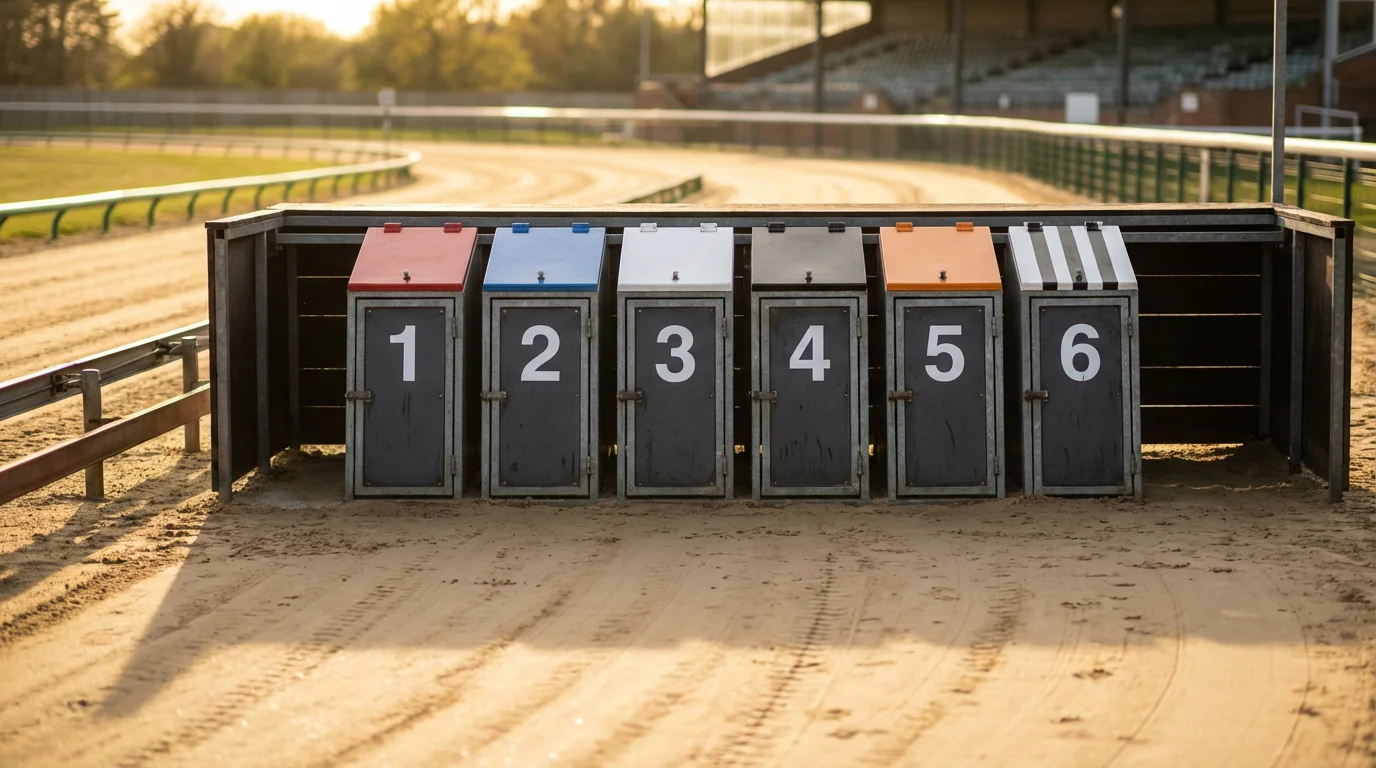
Seeding, as explained earlier, is designed to mitigate the trap draw's impact by placing railers inside and wide runners outside. In graded racing, this system works reasonably well. A railer in trap 1 gets the rail and runs its preferred line. A wide runner in trap 6 takes the wide route and stays out of traffic. The system breaks down in two scenarios: when a dog is borderline between seeding categories and gets a suboptimal draw, and in open races where the draw is entirely random.
Open races produce the most dramatic trap draw mismatches. A confirmed railer drawn in trap 6 faces a structural nightmare: it must break fast, angle sharply towards the rail, and navigate four or five other dogs before it can establish its preferred line. Even a dog with elite ability can lose two or three lengths in this transition — and in a race lasting under thirty seconds, that deficit is often irrecoverable. Conversely, a railer drawn in trap 1 in an open race where no other dog wants the rail has an uncontested path to the first bend. The racecard shows this. The price often does not fully reflect it.
Trap bias is the statistical manifestation of this geometry. At tight-bending tracks like Romford, inside traps produce significantly more winners than the expected average of 16.7% per trap. Trap 1 at Romford, for example, has historically won around 20-22% of races over the standard sprint distance — a substantial edge over what random chance would predict. At bigger, galloping tracks with wider bends and a longer run to the first turn, the bias flattens. Towcester is one of the fairest tracks in the country because the sweeping bends and long straights give every trap a genuine chance.
For punters studying today's card, the practical application is clear. First, identify each dog's running style from the seeding designation and recent form remarks. Second, check whether the trap draw supports that running style. Third, look for mismatches — dogs whose ability is disguised by a poor draw, or dogs whose form is flattered by a series of ideal draws. A dog that has won its last three races from trap 1 may be a very different proposition if today's card puts it in trap 5. The dog has not changed. The opportunity has.
The strongest betting angle on any racecard is a dog with proven early pace, drawn in a trap that gives it a clear run to the first bend, racing against a field where no other runner challenges for the same racing line. When you find that alignment, the price is often the only question left to answer.
Two scenarios from the same race
Scenario A: Well-drawn outsider
Trap 1 — Railer with fast splits (3.88 average), dropping in class. Price: 5/1.
No other railer in the field. Clear run to bend. Grade drop suggests it can compete.
Scenario B: Badly-drawn favourite
Trap 5 — Confirmed railer, fastest on CalcTm but drawn wide in an open race. Price: 6/4.
Must cross four dogs to find the rail. Split time advantage neutralised by traffic. The market sees the ability. The card shows the obstacle.
UK Greyhound Tracks That Race Today
Eighteen tracks, racing almost every day of the year — but not every track suits every dog. The UK greyhound racing circuit, licensed and regulated by the Greyhound Board of Great Britain, spans eighteen stadiums from Sunderland in the north to Hove on the south coast. Each track has its own circumference, bend tightness, standard distances, and trap bias characteristics. A dog's form at Romford is not transferable to Nottingham without significant adjustment, because the two tracks present fundamentally different physical challenges.
The daily racing schedule is driven primarily by the BAGS contract — the Bookmakers' Afternoon Greyhound Service, which supplies live racing content to UK betting shops during the daytime. BAGS meetings typically run from late morning through to early afternoon, featuring graded racing at a rotation of participating tracks. In 2026, the BAGS schedule continues to provide the backbone of daily greyhound betting in the UK, with meetings broadcast into every licensed bookmaker and streamed online through the major operators.
Evening meetings, often branded as BEGS (Bookmakers' Evening Greyhound Service) fixtures, tend to feature higher-grade racing, open events, and the kind of competitive fields that attract more informed money. Tracks like Romford, Nottingham, and Newcastle regularly host evening cards that are televised on RPGTV or Sky Sports Racing. If you are studying form for tonight's card, the evening meetings are where you will find the deepest markets and the sharpest price movements.
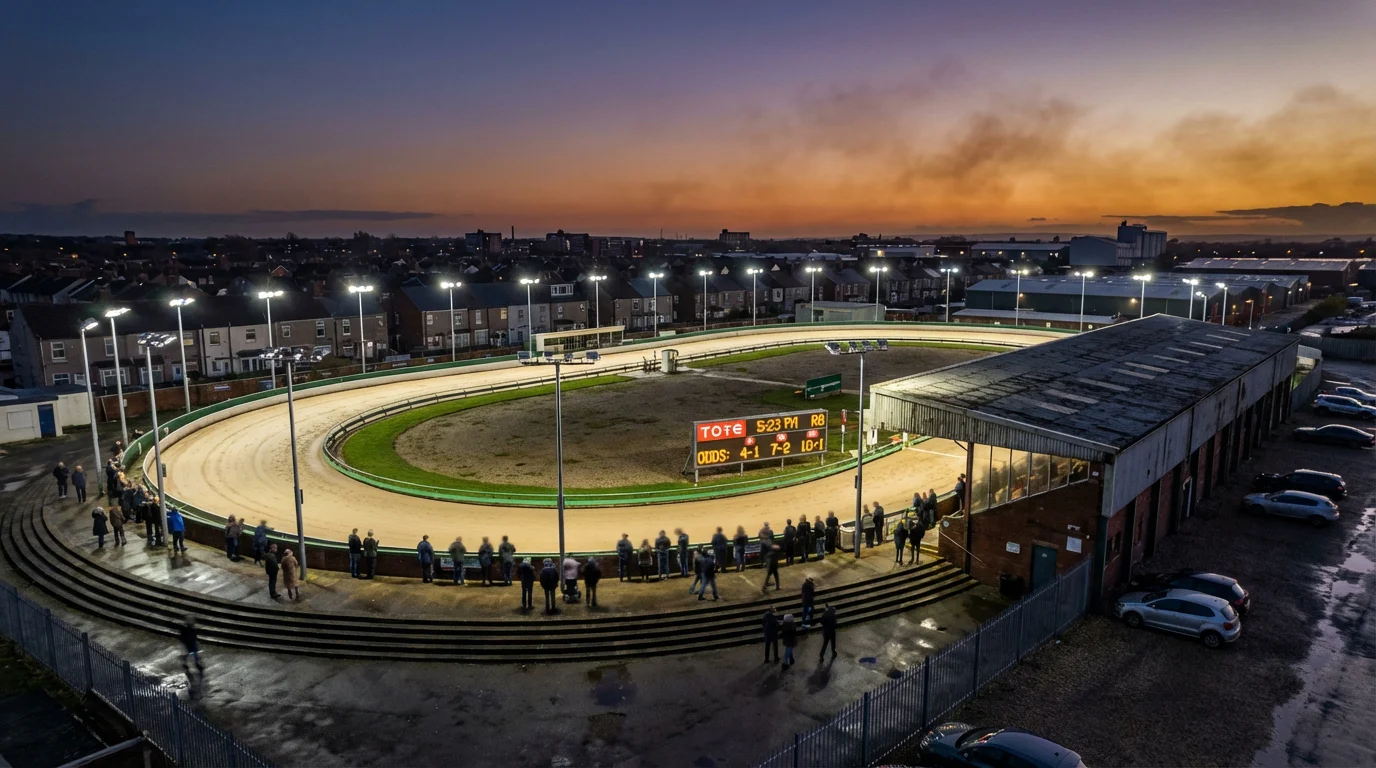
Romford is the archetypal tight-bending track. The run from the traps to the first bend is short, inside traps dominate, and early pace is essential. Nottingham is the opposite: a galloping circuit with wider bends and longer straights that give strong finishers room to close. Trap bias at Nottingham is less pronounced, and dogs that stay on in the closing stages of a race often fare better than pure speedsters. Towcester hosts the English Greyhound Derby, the sport's premier event, which draws the deepest ante-post markets on the calendar. The track's sweeping bends and long straights make it one of the fairest circuits in the country, giving every trap a genuine chance.
Newcastle is one of the fastest tracks in the UK by surface speed, producing quick times across its standard distances. Monmore Green near Wolverhampton runs a 480-metre standard trip and is considered a fair, relatively unbiased circuit. Sheffield Owlerton is another galloping track that rewards dogs with stamina. Hove, near Brighton, runs on a tight configuration closer to Romford in character. Dunstall Park in Wolverhampton, which opened in September 2025 after replacing the former Perry Barr track in Birmingham, is the newest addition to the GBGB circuit. Doncaster, Sunderland, Central Park (Sittingbourne), Kinsley, Yarmouth, Oxford, Pelaw Grange, Towcester, and Harlow complete the GBGB map — each with quirks that repay specialist study.
Seasonal variation affects fixtures more than most punters appreciate. Abandonments due to extreme cold, waterlogged sand, or high winds are not uncommon during the winter months, and evening meetings are particularly vulnerable. The fixture list published in the morning is not always the fixture list that runs in the evening. Checking the latest fixture updates on the GBGB website or through a data provider like Timeform before placing any bet is not optional — it is baseline due diligence.
For punters looking to specialise, the most productive approach is to pick two or three tracks and learn their characteristics in detail. Study the trap bias at each distance. Learn which trainers are based locally and carry the best strike rates. Understand how going conditions affect times at that specific venue. A punter who knows Romford inside out will consistently identify value that a generalist, scanning six tracks a night, cannot.
DO
- Check today's fixture list before placing any bet — meetings get abandoned or rescheduled.
- Learn the track characteristics of the venues you bet on most — tight bends, galloping circuits, trap biases.
- Specialise in two or three tracks rather than spreading your analysis across the entire BAGS schedule.
DON'T
- Assume yesterday's fixture list applies today — cards change, meetings move, races get cancelled.
- Transfer a dog's form from one track to another without adjusting for circuit differences.
- Ignore seasonal fixture disruption — winter weather causes more abandonments than most new punters expect.
Greyhound Bet Types You'll Use on Today's Card
The bet type matters as much as the dog — pick wrong and you are burning money on margins. Six dogs, a fast race, and a compressed field create a betting environment where the structure of your wager can be the difference between a profitable evening and a frustrating one. The right bet for a graded race is not necessarily the right bet for an open race, and a bet that makes sense on a six-runner sprint at Romford may be reckless on a staying trip at Nottingham.
A win bet is the simplest and most efficient wager. You back a dog to finish first. If it does, you collect at the agreed odds. If it does not, you lose the stake. Win singles are the foundation of any serious greyhound betting approach because they force clarity: you need a strong view on which dog wins, and you need the odds to represent value. There is no ambiguity and no consolation prize. When you have a confident selection at a price that exceeds your estimated probability, a win single is usually the correct structure.
Each-way betting adds a safety margin. An each-way bet is two bets: one on the dog to win and one on the dog to place (finish first or second in a six-runner race). Place terms in UK greyhound racing are typically one-quarter of the win odds. A dog at 4/1 each way costs two unit stakes — if it wins, you collect both the win and place portions; if it finishes second, you collect the place bet at 1/1 (evens). Each-way becomes mathematically interesting at prices of 4/1 or longer, where the place component offers a meaningful return. At shorter prices, each-way is an expensive hedge that erodes the advantage of your selection.
Forecasts are where greyhound punters earn their money — or expose their ignorance. A straight forecast (SFC) requires you to name the first two finishers in exact order. A reverse forecast (RFC) covers both orderings of your two selections, costing two unit stakes. The computer straight forecast (CSF) dividend is calculated after the race based on the starting prices of the first two finishers, and the returns can be substantial — typical greyhound CSF dividends range from under ten pounds to over one hundred pounds from a one-pound stake, depending on the prices of the placed dogs.
Forecasts reward deep form study. If you can identify the two most likely runners in a race and have a view on which leads the other, a straight forecast offers a higher return than two separate win bets at a lower total outlay. The six-dog field makes forecasts more achievable in greyhound racing than in horse racing, where larger fields exponentially increase the number of possible first-and-second combinations.
Tricasts require the first three finishers in exact order (straight tricast, STC) or in any order (combination tricast, CTC). A combination tricast with three selections covers six permutations at six times the unit stake. With four selections, it rises to twenty-four permutations. Tricasts are high-risk, high-reward structures that work best in wide-open races where no dog clearly dominates. If you find yourself backing a tricast in a race with a clear 4/6 favourite, you are probably overcomplicating a situation that calls for a win single.
Accumulators link selections across multiple races. Doubles, trebles, and four-folds are common. Returns compound with each additional leg, but so does the probability of failure. In greyhound racing, where the favourite wins around 30-35% of graded races, the chance of four consecutive winners is roughly 1-2% even with solid form analysis. Accumulators have their place — small stakes on BAGS daytime cards — but they should not form the core of a disciplined approach.
Forecasts reward deep form study. Singles reward discipline. Know which game you are playing before you fill the bet slip.
Where to Find Today's Best Greyhound Racecards
Not all racecards are equal — the difference is what is behind the numbers. The same race will appear on five different platforms, and each platform presents a different depth of information. Choosing your racecard source is not a trivial decision: the quality and completeness of the data you see directly affects the quality of the analysis you can perform. A free racecard that shows six runners and their last three finishing positions is a different tool from a premium card that includes calculated times, trap bias data, Timeform ratings, and annotated remarks.
Timeform is the benchmark for data-rich greyhound racecards in the UK. Its cards include proprietary Timeform ratings, which assign a numerical score to each runner based on past performance adjusted for conditions — a distillation of the form analysis process into a single comparable number. Timeform also provides detailed sectional times, going adjustments, trainer statistics, and track-specific trap data. The 2026 platform continues to expand its greyhound coverage, with enhanced track-by-track trap bias overlays that update after every meeting. Some content sits behind a paid subscription, but the depth of analysis justifies the cost for regular bettors.
At The Races offers free racecards with a clean interface that displays the essential information — trap, form, times, and remarks — without the premium analytics layer. For punters who prefer to do their own analysis from raw data, At The Races is a solid starting point. The platform also aggregates tips from multiple sources, though the signal-to-noise ratio on aggregated tips varies considerably.
Sporting Life combines racecard data with editorial content: previews, selections, and analysis from specialist greyhound correspondents. The editorial layer is useful for context but should supplement your own form reading, not replace it.
Bookmaker racecards, available within every major UK operator's app, are the most basic in data terms but the most convenient for bet execution. The racecard and bet slip sit on the same screen. The limitation is that bookmaker cards rarely include calculated times, trap statistics, or detailed remarks — they show enough to identify a runner but not enough to assess one properly.
The practical approach is to use a data-rich source — Timeform or At The Races — for your form analysis, then execute bets through your bookmaker's platform. The extra step takes seconds and gives you access to timing data, remarks, and ratings that the bookmaker's own card does not provide. The punters who skip this step and bet directly from the bookmaker's basic card are the same punters who back dogs based on name and price rather than form and conditions.
Free vs paid racecards
Free racecards show you the runners. Paid racecards show you the angles. If you are placing more than a few bets per week on greyhound racing, the incremental cost of a Timeform subscription or similar premium data source is likely to be recovered in the quality improvement of your selections.
Greyhound Cards Today: Your Questions Answered
How do I read a UK greyhound racecard?
A UK greyhound racecard is read in blocks. Start with the race header, which shows the race number, scheduled time, distance, and grade. Each of the six runners is then listed with its trap number and jacket colour, registered name, sire and dam, age, weight, and trainer. Below the identification line sits the form grid: the dog's last six runs showing date, venue, distance, trap drawn, split time, bend positions, finishing position, beaten margins, remarks abbreviations, and the winning time. Key columns to prioritise are the finishing positions (competitiveness), split times (early pace), calculated time (adjusted performance level), and the remarks column (excuses or patterns). Read form left to right for one race, top to bottom for the trend across six races. The six-run sequence is the story — individual runs are just chapters.
How does the trap draw affect a greyhound's chance of winning?
The trap draw is the single most influential variable in greyhound racing because it determines a dog's path to the first bend — and the first bend determines the race outcome more often than any other factor. Dogs drawn inside (traps 1 and 2) have a shorter distance to cover and easier access to the rail, which gives them a measurable statistical advantage at tight-bending tracks like Romford and Hove. At galloping tracks with wider bends, the advantage is smaller but still present. In graded races, seeding places railers inside and wide runners outside to minimise interference. In open races, the draw is random, which can leave fast railers stranded in wide traps with no clear run to their preferred line. Checking the trap draw against each dog's running style is the most time-efficient analysis step on any racecard.
What is calculated time and why does it matter for greyhound betting?
Calculated time (CalcTm) is a dog's raw finishing time adjusted for track conditions on the day it raced. UK greyhound tracks assign a going figure to each meeting — expressed as a positive number for slow going, negative for fast, and N for normal — that represents how many hundredths of a second the surface was running faster or slower than standard. CalcTm subtracts the going allowance from the raw time on slow days and adds it on fast days, producing a standardised figure that allows fair comparison between dogs that raced on different nights under different conditions. Without CalcTm, a dog that ran 29.30 on fast going would appear faster than one that ran 29.50 on slow going, even though the second dog may have been performing at a higher level. CalcTm eliminates this distortion and is the most reliable single number for assessing a greyhound's true speed.
The Racecard Is the Race — Run It Before They Do
Every dog on that card has a story written in numbers. The punter who reads it fastest does not always win — but they never bet blind. That distinction matters more than any single selection, any single race, or any single evening at the dogs. The racecard is not paperwork. It is not a formality printed so that bookmakers have something to put on the screen between the odds. It is the most concentrated source of actionable information available to anyone betting on greyhound racing in the UK, and it is handed to you for free before every single race.
The overwhelming majority of casual greyhound bettors never look past the dog's name, the trap colour, and the price. They back the favourite because it is the favourite. They back trap 1 because someone told them inside traps win more. None of these approaches is entirely wrong — favourites do win roughly a third of the time, and inside traps do carry a statistical edge at many tracks. But none is sufficient. They are starting points dressed up as strategies, and the racecard is offering far more to anyone willing to read it properly.
The ten per cent of punters who study the card — who compare split times, read the remarks column, cross-reference the grade with the dog's trajectory, and check the trap draw against the running style — do not always find the winner. But they always know why they lost, and knowing why you lost is the prerequisite for learning how to win more often.
Form patterns shift. New dogs arrive from Ireland, from puppy development, from kennel switches. Tracks change configurations. Going conditions swing with the weather. The racecard is your daily intelligence briefing on all of it — a document that updates before every meeting, reflecting the latest data from the most recent runs. It rewards attention and punishes indifference. It is the same tool available to the bookmaker's traders, the professional backer, and the Saturday evening pub punter. The difference is not access. The difference is effort.
Open the card. Read the form. Check the splits. Study the draw. Then — and only then — look at the price. If the price says the market agrees with your assessment, the bet is probably fair but not valuable. If the price says the market has missed what you have seen in the numbers, you have an edge. And if the card tells you nothing worth betting on, close it and wait for the next meeting. That patience, more than any system or shortcut, is what separates the punters who survive from the ones who do not.
