Greyhound Trap Draw & Running Lines — Betting Edge
 Available in US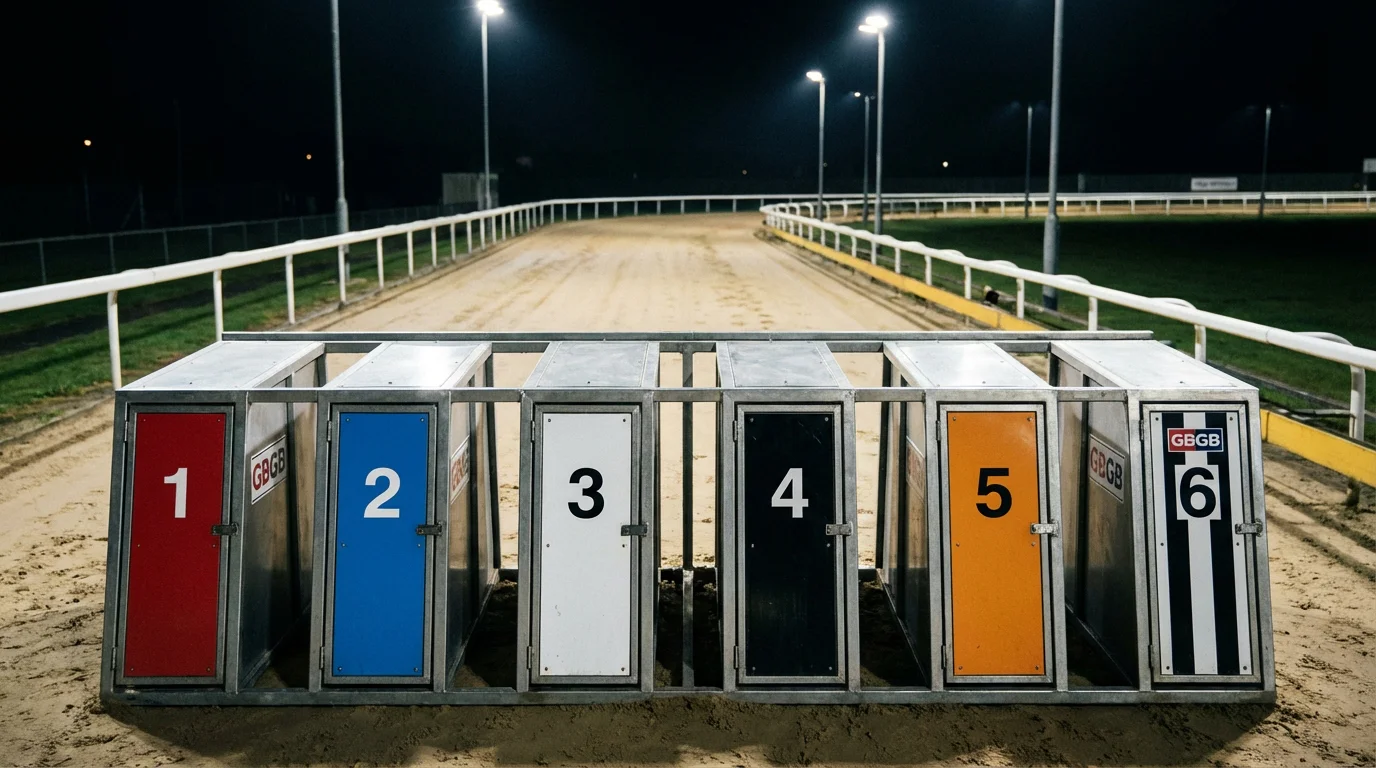
The Most Important Number on the Racecard
Ask any greyhound professional the three most important things in a race. They’ll say the same word three times. The trap draw — that single digit between 1 and 6 printed next to each dog’s name — carries more predictive weight than any split time, any calculated time, any grade classification on the card. It determines where the dog starts, which path it takes to the first bend, how much ground it has to cover through the turns, and whether it arrives at each bend in clear air or in a wall of bodies. Every other factor on the racecard operates within the framework the draw creates.
The logical chain runs like this: draw determines early position. Early position determines first-bend position. First-bend position determines clear running — or crowding. Clear running through the bends determines the dog’s ability to race at its natural speed without interference. And natural speed, uninterrupted, is what wins greyhound races. Break any link in that chain and the dog’s chances shift. A fast dog drawn badly must overcome geometric disadvantage. A moderate dog drawn perfectly inherits a structural advantage that compensates for inferior ability. Over a large sample of races, the trap number correlates with winning frequency more strongly than any other single variable on the racecard.
This doesn’t mean the best-drawn dog always wins. It means the best-drawn dog wins more often than its form alone would predict, and the worst-drawn dog wins less often than its form suggests. The draw is a probability modifier, not a guarantee. But in a sport where the margins between first and fourth are measured in fractions of a length, a probability modifier of even a few percentage points translates directly into betting value. The punter who incorporates draw analysis into every selection is operating with better information than the one who treats the trap number as decoration.
See how railers, middles and wides are affected in railers middles and wides.
How Greyhound Seeding Works
Seeding is the Racing Manager’s puzzle — and the punter’s first clue. In graded races, dogs are not randomly assigned to traps. The track’s racing manager allocates each dog to a trap based on its observed running style, using a classification system governed by the GBGB Rules of Racing that aims to place every dog in a position that suits its natural racing line. The goal is to produce safe, competitive racing where dogs aren’t forced into unnatural paths that create crowding and injury risk. For the punter, the seeding system is informational gold: the trap number itself tells you how the racing manager expects the dog to run.
The system classifies dogs into three running styles, and that classification is reflected in their trap assignment. The specific letters — or the absence of them — that appear beside a dog’s name on the racecard reveal where the racing manager believes the dog naturally wants to run. Understanding this classification is not optional for serious form analysis. It’s the foundation.
Railers, Middles and Wides Defined
A railer is a dog that naturally seeks the inside rail through the bends. On the racecard, railers either carry no designation or are marked with an “r.” They are seeded into traps 1 and 2, the inside positions from which they can reach the rail with the shortest path. A railer drawn in trap 1 has the ideal position: it breaks, moves to the rail immediately, and takes the shortest route through every bend. The same dog drawn in trap 4 or 5 would need to cut across other runners to reach the rail — a move that creates traffic problems and usually costs ground.
Middle runners, marked with an “m” on the card, race in the central portion of the track. They don’t hug the rail and they don’t swing wide — they run a balanced line through the bends that keeps them between the railers inside and the wide dogs outside. Middle runners are seeded into traps 3 and 4. Their running style is less positionally extreme, which means they are affected less by draw than railers or wides — but they are also more vulnerable to being squeezed from both sides in a crowded field.
Wide runners, marked with a “w,” naturally take an outside path through the bends. They are seeded into traps 5 and 6, the outside positions. A wide runner drawn in trap 6 has room to swing out without interference, but it also covers more ground on every bend. The geometric cost of running wide is real and measurable — roughly a length per bend at most tracks — which means wide runners must be faster than the inside dogs to win over the same distance. The trade-off is that wide runners in their correct position often enjoy a clean, interference-free run, because no other dog occupies the same space on the track.
Open Race Draws: Random and Dangerous
Open races — unrestricted by grade, featuring the strongest dogs at the track — operate under different rules. The trap draw in opens is random, meaning a confirmed railer might land in trap 6 and a wide runner in trap 1. The racing manager’s seeding system doesn’t apply, and the result is a field where running styles and draw positions are mismatched by design.
This randomness creates two effects that punters should anticipate. The first is chaos: when dogs are drawn against their natural lines, the first bend becomes more congested and less predictable. Railers breaking from outside traps will attempt to cut across the field to reach the rail, creating traffic that disrupts the mid-field runners. Wide dogs drawn inside may hesitate or angle outward earlier than expected, compressing the space for everyone else. The second effect is opportunity. When the market prices an open-race favourite based primarily on its form figures without adequately discounting for a bad draw, the price overestimates the dog’s true chance. The punter who recognises that the favourite’s form was achieved from favourable draws and that today’s trap is working against it can find genuine value in opposition — either backing a dog whose draw suits its style or simply opposing the favourite at what amounts to a shorter price than the true probability warrants.
The First Bend: Where Races Are Won and Lost
Six dogs converge on one bend in under four seconds. The one with the clearest path wins more often than the fastest. The first bend is the bottleneck of every greyhound race, and understanding its dynamics is essential for anyone who wants to move beyond surface-level form reading.
When the traps open, six dogs break simultaneously and accelerate toward a turn that accommodates roughly two to three dogs abreast at racing speed. Six into three doesn’t go. The compression happens within the first few strides: the inside dogs angle toward the rail, the outside dogs run their line or attempt to tuck in, and the middle dogs get caught between both movements. In the space of three to four seconds, the field rearranges itself from a horizontal line of six into a vertical string of dogs navigating the bend in single or double file.
The dog that arrives at the bend first, on the rail, in clear air, has an advantage that is almost impossible to overcome from behind. It takes the shortest route through the turn, loses no momentum to checking or balancing, and enters the back straight with an unobstructed view of the hare. Every dog behind it must either follow in its wake — losing ground with every stride — or attempt to pass on the outside, which adds distance and requires superior raw speed. The physics are not complicated: the shortest path at the highest maintained speed wins, and the first bend is where that equation is set for the remainder of the race.
Early speed and draw combine to determine first-bend position. A dog with a fast split from an inside trap is the most likely first-bend leader, because it arrives at the turn before the field converges and does so from the shortest possible starting position. A dog with a fast split from an outside trap may arrive at the bend equally quickly in terms of time but must negotiate more traffic to secure a position on the rail — and if it can’t get there cleanly, it’s running wide through the turn despite its speed. The interplay between raw early pace and starting position is the fundamental calculation in greyhound race prediction.
Crowding at the first bend is the most common cause of interference in greyhound racing. Dogs being bumped, checked, squeezed, or forced off their line are events that happen at the first turn with far greater frequency than at any subsequent point in the race. When you see the remarks “Crd1” or “Bmp1” in a dog’s form, that’s first-bend trouble — and it usually traces back to the combination of draw position and early speed relative to the dogs in adjacent traps. A slow-starting dog in trap 3, flanked by fast starters in traps 2 and 4, is structurally likely to be squeezed at the first bend regardless of its ability. The draw created the problem. The form remark recorded it.
The practical lesson: when assessing any race, mentally simulate the first bend. Which dogs are likely to be at the front? Which are likely to be at the back? Where will the crowding happen? If you can project the first-bend scenario with reasonable accuracy, you’ve predicted the shape of the race — and from there, the most likely outcome follows naturally.
Trap Bias: When the Track Itself Has a Favourite
Some tracks are rigged by geometry — not corruption, but concrete and sand. Trap bias is the measurable tendency of certain trap positions to produce more winners (or fewer) than probability alone would predict at a given track. In a perfectly neutral six-trap race, each trap would win approximately 16.7% of the time over a large sample. In reality, most UK tracks show significant deviations from that baseline, and those deviations are consistent enough across years of data to be considered structural features of the track rather than statistical noise.
The primary driver of trap bias is the run to the first bend combined with the tightness of the bends. At tracks with a short run-up and sharp turns, the inside traps — 1 and 2 — produce more winners than expected because the dog in those positions reaches the bend first, on the rail, and the sharp turn amplifies the inside advantage by penalising any dog running wide. At tracks with a longer run-up and more gradual bends, the bias flattens because the field has more time to sort itself before the turn arrives, and the wider bends impose less geometric penalty on outside runners.
Romford is the classic example of a strong inside bias. Trap 1 at Romford has historically won well above the 16.7% baseline, often approaching 22-25% over rolling twelve-month samples. Trap 6 at the same track underperforms, winning closer to 10-12% of races. That’s a gap of ten to fifteen percentage points — enormous in a sport where betting margins are typically in single digits. A punter who blindly bets trap 1 at Romford won’t get rich, but they’ll outperform a punter who picks traps at random by a statistically meaningful margin.
Track width also contributes. A narrow track compresses the field and gives inside runners less space to be passed, reinforcing the rail advantage. A wide track allows outside runners to race without being hemmed in, and the extra room reduces the extent to which inside position translates into race position. The run-in — the straight from the final bend to the finishing line — matters too. A long run-in gives backmarkers time to close, which moderates the first-bend advantage. A short run-in means the first-bend leader can hold on more easily, amplifying the benefit of an inside draw.
Where to find trap statistics: the GBGB website publishes track-specific data, and premium services like Timeform and At The Races provide historical trap-win percentages. When studying a track for the first time, pull the trap statistics before analysing any individual race. The bias figures won’t tell you who wins today’s race, but they set the baseline against which every draw assessment should be made. If trap 1 wins 24% of races at a given track and trap 6 wins 11%, a dog drawn in trap 1 starts with a structural advantage that the form figures don’t capture — and your analysis needs to account for it.
When to Oppose a Badly Drawn Favourite
The favourite at 4/6 drawn out of its comfort zone is the worst bet in greyhound racing. Markets price favourites primarily on form — recent results, calculated times, grade position — and often underweight the impact of an unfavourable draw. The dog that won its last three races from trap 2 at Romford might be 4/6 for today’s race from trap 5, and the price implies a similar level of dominance. But the conditions are fundamentally different: the dog that led from the inside in those three wins now has to break from the outside, navigate across the field to find the rail, and hope that nothing blocks its path during the first bend. The probability of reproducing those performances is materially lower. The price should reflect that. When it doesn’t, opposing the favourite becomes a value play.
The framework for identifying these opportunities is straightforward. First, check the favourite’s recent form for draw consistency. If its best runs were all from the same area of the traps — particularly traps 1 or 2 for a railer, or traps 5 or 6 for a wide runner — and today’s draw is on the opposite side, the form is less reliable as a predictor. Second, check the dog’s remarks from any previous runs when it was drawn against its style. If it’s raced from an unfavourable trap before and performed poorly with remarks like “Crd” or “VW” or “SAw,” there’s evidence that the draw disrupts its running pattern. Third, assess the rest of the field. Is there a dog at a bigger price whose form and draw align more naturally? A 5/1 shot with moderate form but a perfect draw against a 4/6 favourite with strong form but a poor draw can be a better bet — not because the longer-priced dog is the better animal, but because the value equation, adjusted for draw, tips in its favour.
Opposing favourites requires conviction and tolerance for losing. The favourite is the favourite for a reason, and it will overcome bad draws often enough to make the opposer look wrong on plenty of individual races. The edge doesn’t appear in any single race. It appears over fifty or a hundred races, where the cumulative effect of backing draw-advantaged dogs at longer odds against draw-disadvantaged favourites at short odds produces a positive return. This is systematic betting, not emotional betting, and the system only works if you apply it consistently rather than abandoning it after a favourite defies its draw and wins comfortably.
One nuance: not all running styles are equally affected by bad draws. A confirmed railer drawn in trap 5 faces a severe displacement — it must cross four dogs’ width to reach its natural running line. A middle runner drawn in trap 1 faces a lesser adjustment — it only needs to move one position outward from the rail to find its preferred path. The severity of the draw mismatch should calibrate the strength of your opposition. A railer in trap 6 is a strong lay. A middle in trap 2 is a marginal concern. Read the mismatch, price the impact, and act accordingly.
The Single-Seeded Runner Edge
Five railers and one wide runner in trap six — that’s not a race, that’s a gift. The single-seeded runner scenario is one of the most reliable structural edges in graded greyhound racing, and it appears on cards more often than most punters realise. It occurs when five of the six dogs in a race share the same running style — typically five railers — and the sixth dog has a different style, usually seeded into the trap that corresponds to its natural line.
The mechanics of why this works are simple. The five railers will all attempt to reach the inside rail at the first bend. That’s five dogs converging on the same strip of track, and the result is predictable: crowding, checking, bumping, and a loss of momentum for most or all of them. Meanwhile, the sole wide runner in trap 6 breaks, swings out to its natural wide line, and encounters nothing. No traffic. No interference. A clear, unobstructed run through the first bend while its five rivals are sorting out the mess on the rail.
The advantage is not about speed. The wide runner in this scenario doesn’t need to be the fastest dog in the race. It needs to be quick enough to stay in contact through the first bend — which its clear run ensures — and then capitalise on the ground lost by the railers through interference. In many cases, the single-seeded runner wins or places simply by avoiding the trouble that its rivals inflict on each other. The dog runs its own race, uninterrupted, while the competition self-destructs.
Spotting this on the card requires only a glance at the seeding markers. If five dogs carry no marker (or “r”) and one carries a “w,” the race has a single-seeded wide runner. If five dogs are marked as wides and one is a railer in trap 1, the same principle applies in reverse — the lone railer gets the rail to itself while the wides compete for the outside. The mirror scenario is less common but equally valuable when it appears.
The market often underprices the single-seeded runner because the dog’s raw form may be inferior to the five rivals. Its CalcTm might be slower, its recent results might be modest, and the favourite in the race might have clearly superior credentials on paper. But paper form assumes a clean run, and the structural reality of this race is that the favourite — drawn among four other dogs with the same running style — is less likely to get a clean run than the single-seeded outsider. When the market offers 5/1 or 6/1 on the lone wide runner in a race full of railers, the price often underestimates the dog’s true chance of being in the frame. That gap between market price and structural probability is where the value sits.
Draw Your Own Conclusion
The trap number doesn’t guarantee anything. It just tilts the odds — and tilting odds is the entire game. A perfectly drawn dog can still miss the break, get bumped at the second bend, or simply not run to its best on the day. A badly drawn dog can find an unexpected gap, benefit from a first-bend pile-up that clears the field, or produce a career-best performance that overcomes every geometric disadvantage. Individual races are unpredictable. That’s the nature of the sport, and it’s what makes it compelling.
But over a hundred races, the draw wins. Statistical evidence from every GBGB track confirms that trap position is the strongest single predictor of race outcomes, more consistent than form, more reliable than class, and more durable than any other factor the racecard provides. The punter who incorporates draw analysis into every assessment doesn’t guarantee better results on any given Tuesday evening. Over a season, though, the cumulative advantage of aligning selections with draw strength — and opposing selections when the draw works against them — produces a measurable edge that no other single analytical tool matches.
The danger is overweighting the draw to the exclusion of everything else. A dog with terrible form drawn in trap 1 at a track with strong inside bias is not automatically a good bet. The draw improves its chance relative to what its form alone would suggest, but it doesn’t turn a poor dog into a contender. Draw analysis works best when layered on top of solid form assessment, sectional analysis, and grade evaluation. It’s the modifier that adjusts your assessment upward or downward after you’ve done the analytical groundwork. Treat it as the final filter, not the first. A good selection is a dog with the form to compete, the speed to be competitive, and the draw to express its ability without structural interference. Get all three aligned and you’ve found a bet worth making.
Greyhound racing offers six traps, six dogs, and a bend that separates them within seconds. The punter who understands the draw understands the geometry of the sport itself — and geometry, unlike form, doesn’t have off days.
Study trap draw and running lines on the greyhoundcardstoday homepage.
