Railers, Middles and Wides in Greyhound Racing
 Available in US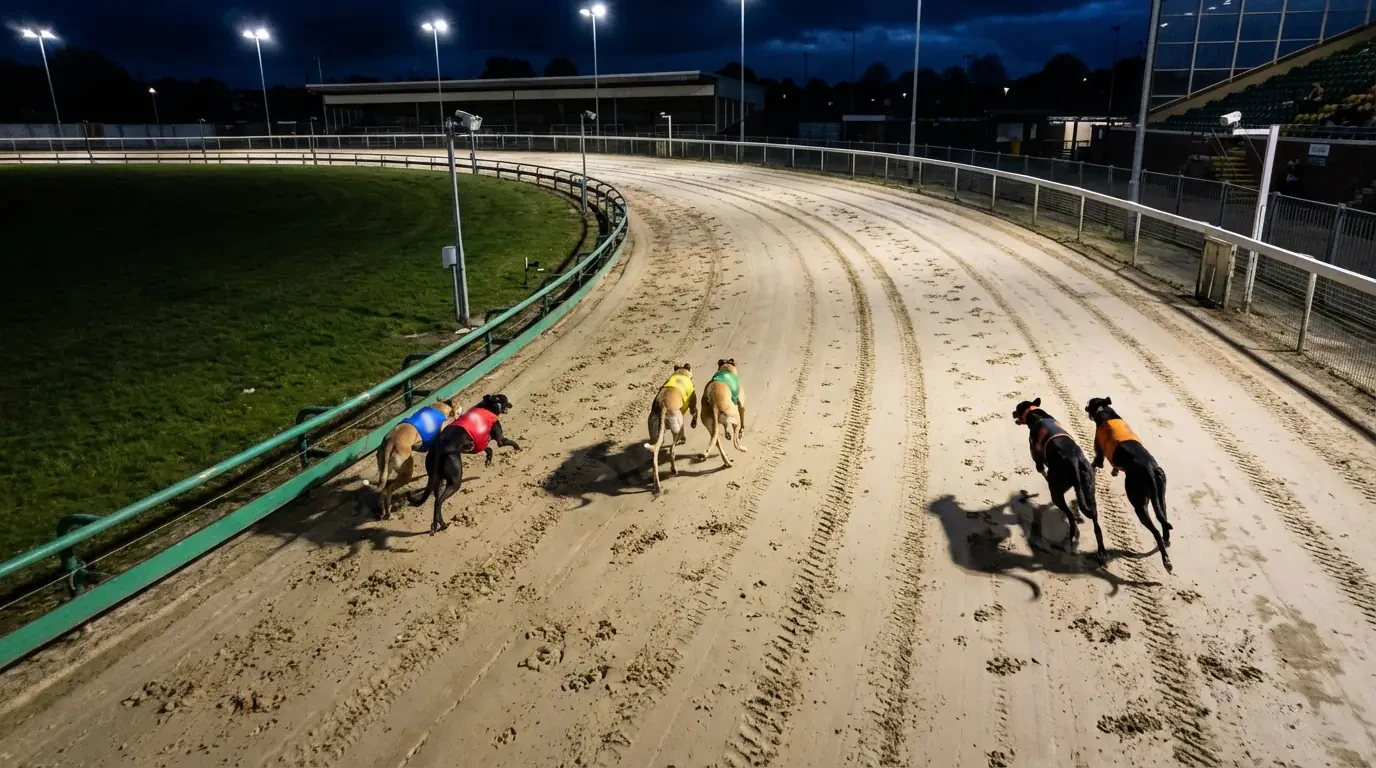
The Line a Dog Runs Is the Dog
Every greyhound has a natural running line — the path it takes around the track once the traps open and instinct takes over. Some dogs hug the inside rail as though glued to it. Others swing wide around every bend, covering extra ground but avoiding traffic. A third group sits somewhere in between, flexible enough to adapt but often without a dominant preference in either direction. These three categories — railers, middles, and wides — are not arbitrary labels. They describe a fundamental behavioural trait that shapes how a dog races, where it gets into trouble, and which trap draws help or hurt its chances.
On the racecard, running line is expressed through two things: the seeding (which trap the Racing Manager has assigned based on the dog’s style) and, where the notation is used, the letter “m” for a middle runner or “w” for a wide runner beside the dog’s name. Railers carry no letter — the absence of a marker is itself the label. If you see a dog in trap one with no running-line designation, you are looking at a railer. If you see a “w” beside the name of a dog in trap six, you are looking at a confirmed wide runner placed where its style has the most room.
Understanding running lines is not optional for serious greyhound form analysis. It is the variable that connects the trap draw to the first bend, and the first bend to the result. A dog’s speed, form, and grade tell you what it can do. Its running line tells you where it will try to do it — and whether today’s trap gives it the chance.
Factor in the trap draw when assessing running positions in trap draw running lines.
Railers: The Inside Track
Railers are the inside dogs. They break from the traps and drive towards the rail, aiming to take the shortest possible route around every bend. In greyhound racing geometry, the inside line is always the shortest line. A dog that hugs the rail around four bends covers measurably less ground than a dog running two or three lanes wide. Over 480 metres, the distance saving can equate to a length or more — which, in a sport where races are frequently decided by half a length, is a meaningful advantage.
Railers drawn in trap one or two are in their element. They break from the inside position and reach the rail with minimal lateral movement. They do not need to cross the path of other runners, and they enter the first bend on the shortest line by default. This is the ideal scenario for a railer, and it is why trap-one railers with early pace are among the most reliable selections in graded greyhound racing.
The problems start when a railer is drawn wider — trap three, four, or worse. From an outside position, the railer’s instinct drives it inward towards the rail, but to get there it must cut across the paths of dogs running inside it. If those dogs are also heading for the rail, congestion and contact are almost inevitable. A railer drawn in trap five faces an acute version of this problem: it wants to be on the rail, but four dogs stand between it and that rail at the first bend. The dog either fights through traffic and gets crowded, or is forced to run wider than its nature dictates and loses the advantage its running style is designed to create.
Punters who back railers should always check the trap draw first. A railer in trap one or two with good early pace is a bet worth considering. A railer in trap five or six is a bet to oppose, regardless of how impressive its recent form looks — because that form was almost certainly produced from an inside draw. Running line is not a skill the dog can override. It is a behavioural pattern hardwired over dozens or hundreds of races.
Middle Runners: Versatility or Vulnerability
Middle runners, marked “m” on the racecard, are the most flexible category. They do not commit to the rail and they do not swing wide. They run through the middle of the track, adapting their line based on where the gaps appear. This adaptability sounds like an advantage, and in some situations it genuinely is — a middle runner in a race where the railers are crowding the inside and the wides are drifting outward can exploit the space in between and come through cleanly.
But flexibility is also the middle runner’s weakness. A dog without a strong directional preference is a dog without a clear route through traffic. Railers know where they are going. Wides know where they are going. Middles are, to some extent, at the mercy of the race as it unfolds around them. If the field fans out evenly, the middle runner has room. If the field compresses towards the centre — which happens when railers are pushed outward and wides are pushed inward — the middle runner is caught in the squeeze.
Middle runners are typically drawn in traps three or four, which places them in the centre of the starting line. From here they have options: they can drift toward the rail if space appears, or hold a middle path, or even run slightly wide if the inside is congested. The quality of a middle runner is often determined not by speed but by racing intelligence — the ability to find room in real time and avoid being caught in trouble.
For punters, middle runners are harder to assess than railers or wides. Their performance is more race-dependent and more sensitive to the specific opposition they face on the day. A middle runner’s form from a race where it found a clear lane may be misleading if today’s card features more congestion. Always look at the remarks column for middles: how often are they crowded? How often do they find room? A middle runner that consistently avoids interference has genuine racing sense. One that regularly gets checked or bumped is probably a dog that lacks the decisiveness to commit to a line under pressure.
Wide Runners: The Outside Lane
Wide runners swing outward around every bend. They cover more ground than railers, which in raw distance terms is a disadvantage. But the trade-off is clean running. A wide dog on the outside avoids the densest traffic, which gathers at the rail and the first two lanes on every bend. While railers and middles are fighting for position through crowded bends, the wide runner is running in open air, three or four lanes from the rail, with nothing to impede its stride.
The economics of wide running work like this: a wide dog covers perhaps two to four extra metres per circuit compared to a railer. At racing speed, that translates to roughly half a length to a length of lost ground. But if the railer is checked, bumped or crowded at the first bend — losing two or three lengths of momentum — the wide runner’s clean passage more than compensates for the extra distance. The wide dog’s edge is not speed; it is uninterrupted running.
Wide runners drawn in trap five or six are in their natural position. They break outward from the widest gates and take the outside line to the first bend without crossing anyone’s path. This is the mirror image of a railer in trap one: the dog’s instinct and the draw are aligned. From trap five or six, a wide runner should have a clear run to the first bend and a smooth passage around it, emerging on the back straight without interference.
The reverse is equally true. A wide runner drawn in trap one or two faces a miserable proposition. Its natural instinct will pull it outward, but the starting position is at the rail. To reach its preferred running line, it must drift across the entire field during the sprint to the first bend — losing ground, disrupting other runners, and arriving at the bend out of position and out of rhythm. Back a wide runner from an inside draw only if you enjoy watching money disappear.
The most profitable wide-runner scenario in greyhound betting is the sole wide runner in a field of railers. If five dogs are seeded as railers and one is seeded wide in trap six, the wide runner may have the outside entirely to itself while all five railers compete for one narrow strip of rail. In those races, the wide runner does not need to be the fastest dog in the field — it just needs to avoid the carnage on the inside and run its own race. The racecard makes this setup easy to identify: look for a “w” in trap six and no other wide runners in the field.
Running Line as Racing DNA
A dog’s running line is not a tactic. It is not a decision the dog makes consciously, and it is not something the trainer can easily change. Running style is established early in a greyhound’s racing career — often in the schooling and trialling stages — and it tends to remain consistent throughout the dog’s racing life. A railer at two years old is a railer at four years old. A wide runner does not become a railer because it has been drawn inside three times in a row.
This consistency is what makes running-line analysis so reliable for punters. Unlike form, which fluctuates with fitness, competition, and luck, running line is stable. You can trust that a dog marked as a railer will try to reach the rail in today’s race, just as it did in the last ten races. You can trust that a wide runner will swing out. And you can use that trust to predict how the first bend will unfold — which dogs will converge, which will spread out, and where the space will be.
The draw is not destiny, but it is the frame. The running line is the dog’s response to that frame. When draw and running line align, the dog has every opportunity to produce its best. When they conflict, you are betting against the dog’s own nature. Over a sample of races, draw-line alignment wins more often than talent alone. That is the edge that running-line analysis provides, and it costs nothing more than reading the racecard properly.
Understand running positions on the greyhoundcardstoday homepage.
