Greyhound Form & Sectional Times — Analysis Guide
 Available in US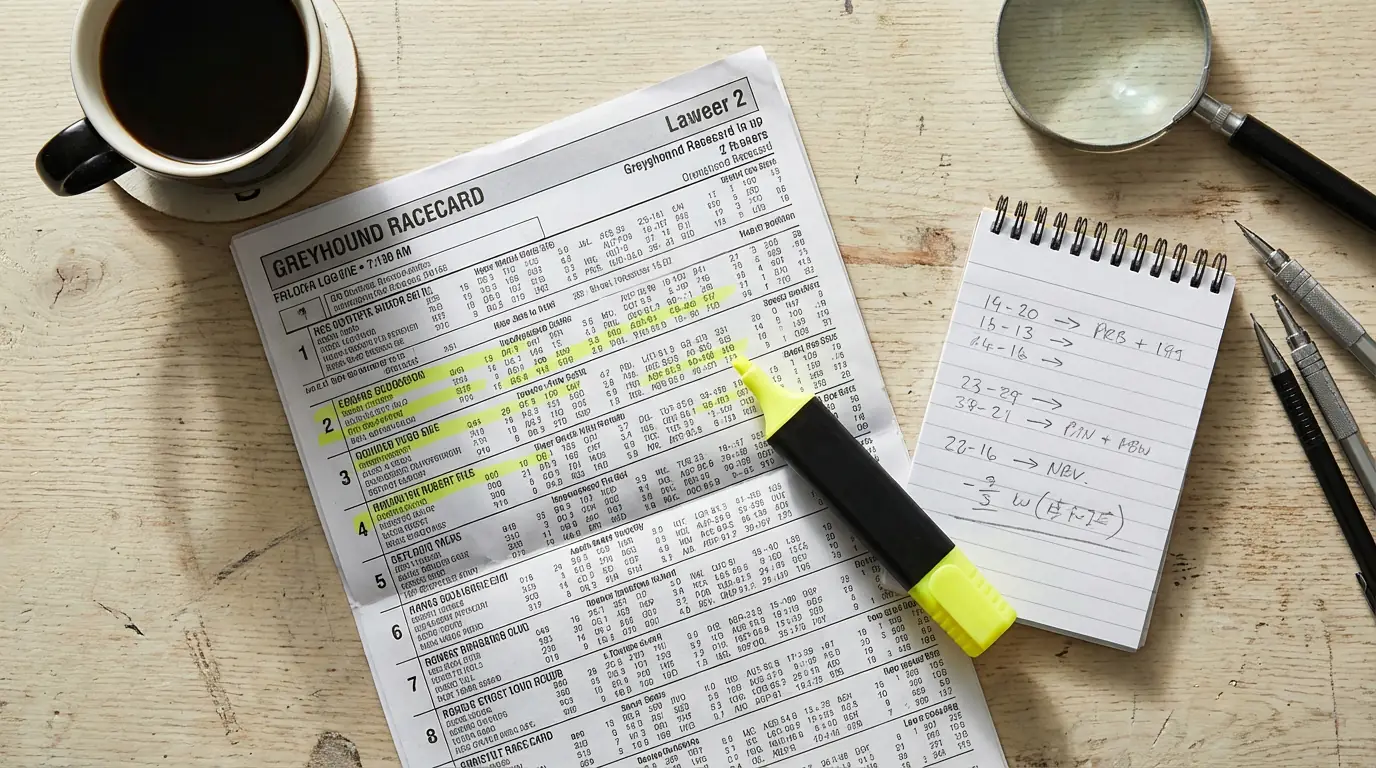
Form Is Not History — It’s a Forecast
Most punters treat form as a museum exhibit. Winners treat it as a weather forecast. The distinction matters because it changes how you read every number on the racecard. When you look at a greyhound’s last six runs and see them as a record of what happened, you’re consuming data passively — filing away results as historical facts. When you look at those same six runs and see them as indicators of what will happen, you’re reading the form actively — scanning for trajectories, patterns, and signals that project forward into the next race.
Greyhound form is unusually reliable for this kind of projection, and the reason is structural. Horse racing introduces variables that greyhound racing strips away: jockey ability, race tactics, weight carried, ground conditions that vary dramatically from firm to heavy, fields of ten to twenty runners creating unpredictable traffic patterns. A greyhound race has six runners, no jockey, no weight variation, a consistent surface, and a mechanical hare that produces a roughly uniform pace. The dog’s performance is, to a much greater extent than in horse racing, a function of the dog itself. When a greyhound’s form declines, the dog is declining. When it improves, the dog is improving. External noise exists — bad draws, crowding, slow starts — but the signal-to-noise ratio in greyhound form is higher than in any other racing code.
This makes form analysis both more rewarding and more demanding. More rewarding because the form figures genuinely predict future performance when read correctly. More demanding because the margin between a sharp form read and a lazy one is thinner — the useful signals are subtler, buried in split-time fractions and remark codes rather than in headline results. The punter who glances at the finishing position of the last three runs is reading history. The punter who examines the sequence of split times, bend positions, remarks, and grade movements across all six runs is building a forecast. The difference in their long-term returns is not small.
Dig deeper into split times in split times explained.
Reading the Form Grid Line by Line
A single run means nothing. A sequence of six tells you everything. The form grid on a UK greyhound racecard displays the dog’s most recent performances in chronological order, and each row packs a compressed race narrative into a dozen or so columns. Reading the grid effectively means treating each column as a separate data stream and then synthesising those streams into a coherent picture of the dog’s current competitive state.
Start with the date and venue columns. These tell you when and where the dog last ran. Frequency matters: a dog racing every four to seven days is in regular competitive condition. A gap of three weeks or more suggests either injury, a rest period, or a trial that hasn’t appeared on the card. The venue column reveals whether the dog’s recent form was achieved at the same track as today’s race or at a different venue, which affects how directly the form translates.
The distance and trap columns set the conditions of each run. Was the dog running over the same trip as today, or was it campaigned at a different distance? Was it drawn in the same area of the traps, or has the racing manager moved it? A dog that ran from trap 2 five times and is now drawn in trap 5 is facing a structural change that the form figures alone don’t capture — the split times and bend positions from those trap-2 runs may not replicate from the outside draw.
The finishing position is the column most punters read and the column that tells you the least in isolation. A dog that finished third tells you nothing until you know: third by how far? Third from what position at the first bend? Third in what grade? Third with what remarks? The finishing position is the headline. The surrounding columns are the article.
Beaten distances quantify the gaps between runners. A dog beaten a neck was competitive to the line. A dog beaten six lengths was outclassed or compromised. Margins matter most when they’re changing: a dog beaten four lengths, then three, then two across consecutive runs is closing the gap — its form trajectory is upward even though it hasn’t won any of those races. A dog that won two runs ago by three lengths and then finished fourth beaten five lengths is moving in the opposite direction. The raw positions (1st, then 4th) tell part of the story. The margins complete it.
Spotting Improving and Declining Trends
Trend identification is the core skill of greyhound form analysis. You’re looking for arcs across the six-run sequence that reveal whether a dog is getting better, getting worse, or holding a consistent level. The indicators sit in multiple columns: finishing positions, beaten distances, calculated times, split times, and grade movement all contribute to the picture.
An improving dog typically shows a combination of progressively closer finishing margins, stable or quickening split times, and movement into higher grades. A dog that was running at A6 three runs ago and is now graded A4 has been promoted on the strength of its performances — the racing manager has assessed it as competitive at a higher level. If its calculated times have also improved across those runs, the promotion is justified by speed as well as results. That dog is on an upward trajectory, and its best performance may still be ahead of it.
Declining form is the mirror image: widening margins, slowing split times, grade drops. But the crucial distinction is between permanent decline and temporary regression. A dog that has lost a step due to age (typically above four years old) is unlikely to reverse the trend. A dog that’s run three poor races after a change of kennel, a layoff, or a sequence of bad draws may be underperforming its true ability. Weight can be a clue — a dog that’s gained a kilogram over three runs might be losing sharpness through condition, while one that’s dropped weight might be returning to peak fitness after a rest. The form grid provides the data. Your job is to decide whether the trajectory is structural or circumstantial.
When a Bad Run Isn’t Bad Form
Crowding, trouble in running, and bad draws mask true ability more often than most punters realise. The remarks column exists precisely to explain why a result doesn’t reflect the dog’s actual performance, and the punters who ignore it are misreading form systematically.
A dog that finished fifth with the remarks “SAw, Crd1, Bmp2” was slow away from the traps, crowded at the first bend, and bumped at the second. It never had a clear run at any stage of the race. Treating that result as genuine form — weighting it equally against runs where the dog had a clean trip — produces an inaccurate assessment. The fifth-place finish was a consequence of interference, not inability. If the same dog’s previous five runs show it finishing first or second with remarks like “EP, Led” and “EvPce, RnOn”, the pattern is clear: this is a competitive dog that had one disrupted run. The bad result is noise, not signal.
Draw-related bad runs are subtler. A confirmed railer drawn in trap 5 is racing against its natural style for an entire race. It may finish poorly not because it’s out of form but because the geometry doesn’t suit it. Checking whether the dog’s recent poor run coincided with an unfavourable draw is a simple step that many punters skip. If the draw returns to a suitable position for the next race, the form that preceded the bad run is the form that matters.
The discipline is learning which bad results to forgive and which to take at face value. Not every poor run has a valid excuse, and overusing the remarks column to explain away decline is its own form of bias. The test is consistency: if a dog’s last three runs all carry interference remarks, it might be the kind of runner that finds trouble repeatedly — not unlucky, but structurally prone to crowding because of its running style. That’s a different assessment from a single isolated incident, and the form reader who distinguishes between the two is operating at a higher level.
Sectional Times: The Hidden Edge
Finishing time tells you who won. Split time tells you who will win next time. The first sectional — the time from the trap opening to the dog’s first crossing of the timing beam — is the most underused and most predictive number on the racecard. It measures early speed in its purest form: how quickly the dog breaks, how efficiently it accelerates, and where it will be when the field reaches the first bend. In a sport where first-bend position determines the outcome more often than raw finishing speed, the split time is the closest thing greyhound racing has to a crystal ball.
A typical split time at a UK track ranges from roughly 3.70 to 4.30 seconds depending on the distance from the traps to the timing point, the track configuration, and the dog’s natural running style. Fast starters — dogs with habitual splits below 3.90 at tracks where the average is 4.00 — will consistently reach the first bend at or near the front of the field. Slow starters, with splits above 4.10 at the same track, will be in the rear group and must rely on the race unfolding favourably ahead of them to find a clear passage through the bends.
The power of sectional analysis lies in comparing splits across the six dogs in today’s race rather than in isolation. Rank the field by their recent average splits, and you’ve built a projected first-bend order. The dog with the fastest split drawn on the inside is the most likely leader. The dog with the slowest split drawn on the outside faces a compounding disadvantage: late to the bend and wide through it. When you overlay the split ranking with the trap draw, the race begins to take shape before the traps open.
One important adjustment: split times from different trap positions are not directly comparable. A dog breaking from trap 1 runs a slightly shorter distance to the timing beam than a dog in trap 6, because the traps are staggered relative to the track’s geometry. The difference is small — fractions of a length — but at the margins that separate greyhound races, fractions matter. A split of 3.88 from trap 1 and a split of 3.92 from trap 6 may represent identical early speed once the positional difference is accounted for. Premium racecard services like Timeform apply these adjustments in their data. If yours doesn’t, factor in a small allowance when comparing splits across different trap positions.
Sectional times also reveal something that finishing positions cannot: how a dog ran even when the result was poor. A dog that posted the fastest split in the race but finished fourth was leading into the first bend and then encountered trouble — bumping, crowding, or being forced wide. The split confirms the dog’s early ability was not in question. The finishing position reflects events beyond the dog’s control. That information is a direct betting signal: the dog has the speed to compete, and a cleaner run next time may produce the result its sectional data has been promising.
Calculated Time and Going: Levelling the Field
CalcTm is the great equaliser — it strips conditions from the equation and leaves pure ability. Two dogs might both clock 29.50 over 480 metres at the same track, but if one ran on a fast surface (going allowance -10) and the other on a slow one (+15), their performances were not equal. The first dog’s calculated time adjusts to 29.60. The second’s adjusts to 29.35. What looked like a dead heat in raw time is actually a gap of over a length in standardised performance.
The going allowance is set by the track’s racing office for each meeting. It represents how many hundredths of a second the surface is running faster or slower than its established standard. Positive numbers mean slower going (soft, wet, sand holding). Negative numbers mean faster (firm, dry, well-packed). The letter N signifies normal — no adjustment needed. The allowance applies to every race at that meeting, and it converts each dog’s raw finishing time into a CalcTm that approximates what the dog would have run on a standard surface.
The mathematics is straightforward. Take the raw finishing time and subtract the going allowance (treating positive allowances as positive numbers to subtract, and negative allowances as negative numbers, effectively adding). A dog that ran 29.80 on going of +20 gets a CalcTm of 29.60. A dog that ran 29.30 on going of -15 gets a CalcTm of 29.45. Now both figures sit on the same baseline, and you can compare them directly — at least within the same track and distance.
The asterisk convention is worth understanding. On many racecards, the dog’s best CalcTm within a recent window (typically the last six runs, sometimes the last ninety days) is marked with an asterisk. This shorthand lets you scan six runners and instantly identify the one whose peak recent performance is the fastest. It’s a useful filter — the dog with the best marked CalcTm deserves closer scrutiny — but it’s not a verdict. A single outstanding CalcTm might reflect a career-best performance that the dog can’t reproduce. The consistency of CalcTm across multiple runs matters more than a single peak. A dog that posts 29.50, 29.55, 29.48, 29.52 across four runs is more reliable than one that posts 29.35, 29.80, 29.70, 29.60 — even though the second dog has the faster single time.
CalcTm has limits, and acknowledging them prevents overconfidence. The going allowance is a single number applied uniformly, but track surfaces aren’t perfectly uniform — the rail can ride differently from the outside, and conditions may change during a meeting as the surface dries or becomes more churned. The formula also doesn’t account for wind, temperature, or the specific pattern of running each dog produced. CalcTm is the best available standardisation tool. It is not a perfect one. Use it as the primary speed comparison metric, but layer it with split times, remarks, and race-shape analysis before committing to a final assessment.
Comparing Form Across Tracks and Distances
A 29.50 at Romford and a 29.50 at Towcester are two completely different performances. Cross-track form comparison is the most treacherous area of greyhound analysis, and the punters who handle it carelessly make systematic errors that compound over time. The problem is that tracks vary in circumference, bend configuration, surface composition, and the precise position of the timing equipment. CalcTm adjusts for going within a single track. It does not adjust for the inherent speed differences between tracks.
A tight, fast circuit like Romford produces lower raw times and lower CalcTm figures than a larger, more galloping track. A dog that runs a CalcTm of 29.40 at Romford is not necessarily faster than one clocking 29.60 at a bigger venue — the difference might be entirely explained by the track geometry. Converting between tracks requires either a track-specific speed rating system (which premium data services provide) or the blunt but functional method of comparing each dog’s CalcTm relative to the track average for its grade. A dog running half a second faster than the average A5 CalcTm at its home track is performing at a similar relative level to another dog that’s half a second faster than the A5 average at a different track, even if their absolute CalcTm numbers differ.
Distance changes introduce a second layer of complexity. When a dog switches from 480 metres to 640 metres, its form over the shorter trip has limited direct relevance. The physical demands of a staying race are different: stamina matters more, early speed matters less, and the dog’s ability to maintain pace through additional bends becomes the key variable. Some dogs that dominate at middle distances lack the stamina for staying trips. Others — particularly those that consistently run on in the closing stages of middle-distance races, finishing strongly but arriving too late — may be ideally suited to a longer trip where their finishing speed has more time to take effect.
The remark “RnOn” (ran on) across multiple middle-distance runs is a signal worth noting when a dog steps up in trip. It indicates the dog was still accelerating at the finish line, which is a direct hint that it might be better suited to a longer distance. Conversely, a dog whose split times are fast but whose finishing positions deteriorate as the race progresses — leading early and fading late — is a sprinter by nature, and a distance increase is likely to expose a stamina limitation that shorter races concealed.
The practical advice: treat cross-track form cautiously and give extra weight to form at today’s track. A dog with four runs at today’s venue and two at a different track has a body of directly relevant data that outweighs the foreign form. When all the recent form is from a different track, adjust your confidence downward by a notch and price in the uncertainty.
Building a Form Profile: The Five-Minute Method
Five minutes per runner. That’s all it takes to separate yourself from 90% of greyhound punters. The method isn’t complicated, but it is systematic — and the system is what prevents you from getting anchored on the wrong data point or distracted by irrelevant detail. Here’s the sequence, designed to extract the maximum useful information from a standard UK racecard in the minimum time.
Start with the split times. Rank all six dogs by their average split over the last three runs. This gives you a projected first-bend order, which is the single most important structural input for predicting the race outcome. Note which dog is likely to lead and which dogs are likely to be at the rear. The leaders have the race in their favour by default — they need something to go wrong to lose their advantage. The backmarkers need something to go right.
Next, check the grade movement. Has any dog been raised or dropped in grade for this race? A grade drop is a signal that the racing manager considers the dog uncompetitive at the previous level — which also means it may be competitive at the new, lower level. A grade rise means the dog has been winning or placing consistently and is being tested against stronger opposition. Grade drops in combination with solid recent CalcTm figures are one of the most reliable value indicators in greyhound form: the dog has the speed to compete but is arriving from a higher-class division, and the market doesn’t always price that correctly.
Third, scan the remarks for excuses. Look specifically at the most recent run for each dog. If the last result was poor, does the remark explain why? A fifth-place finish with “Crd1, Bmp3” is not the same as a fifth-place finish with no remarks. The first result can be forgiven. The second is genuine form. This step takes seconds per runner but changes your assessment materially — it separates the dogs whose form line is accurate from those whose form line is misleading.
Fourth, assess the draw. Cross-reference each dog’s running style (railer, middle, wide — inferred from its seeding and its bend positions in recent form) with today’s trap number. A railer in trap 1 is perfectly drawn. A railer in trap 5 is compromised. A wide runner in trap 6 has room; the same dog in trap 1 may get squeezed. The draw assessment modifies your split-time ranking: a fast starter from a bad draw may not convert its early speed into first-bend position as reliably as its splits suggest.
Finally, compare the CalcTm figures across the field as a secondary speed check. The dog with the consistently best CalcTm over its last three runs has the highest demonstrated performance level. If that dog also shows the fastest split and a favourable draw, it’s a strong contender. If its CalcTm is the best but its draw is poor and its split is middling, the speed may not translate into a winning position — and that tension is where betting value often hides.
Five steps, five minutes, six runners profiled. Write your conclusions on the card or in a notepad — a shorthand note for each runner: “fast split, good draw, improving” or “slow starter, bad draw, class drop.” The act of writing crystallises the assessment and prevents you from second-guessing yourself when the prices appear and the temptation to abandon your analysis sets in.
The Number That Doesn’t Exist Yet
Every racecard ends with a blank column — the one that records what’s about to happen. All the data you’ve just analysed — the splits, the CalcTm figures, the remarks, the grade movement, the bend positions — describes races that have already been run. The next race hasn’t happened yet, and the gap between the form and the outcome is where greyhound betting lives.
Form analysis reduces uncertainty. It does not eliminate it. A dog with the fastest splits, the best CalcTm, a perfect draw, and improving form is a strong candidate, but the traps still open into chaos. A slow break, a bump at the first bend, a slip on soft sand — any one of these turns a strong candidate into a fourth-place finisher. The best form readers in the sport don’t expect to be right every time. They expect to be right often enough that their assessments, applied consistently across hundreds of races, produce a positive return. The individual race is uncertain. The process is not.
Analytical humility is the quality that separates profitable punters from confident ones. The confident punter knows the form. The profitable punter knows the form and knows what it can’t tell them. They price their selections accordingly — shorter when the data alignment is strong, longer when the uncertainties are numerous — and they walk away from races where the form gives no clear signal. Not every card demands a bet. Not every race contains an edge. The discipline to pass on a race is as much a form-reading skill as the discipline to identify a selection.
The racecard is a tool, not an oracle. Use it with rigour, interpret it with nuance, and respect the gap between what the numbers say and what the dogs will do. That gap is permanent. Your ability to navigate it is not — it improves every time you read a card, test your assessment against the result, and adjust your method in response. The number that doesn’t exist yet is the one you’re learning to predict. The form is how you get there.
Analyse form and sectional times on the greyhoundcardstoday homepage.
