Greyhound Open Races vs Graded Races
 Available in US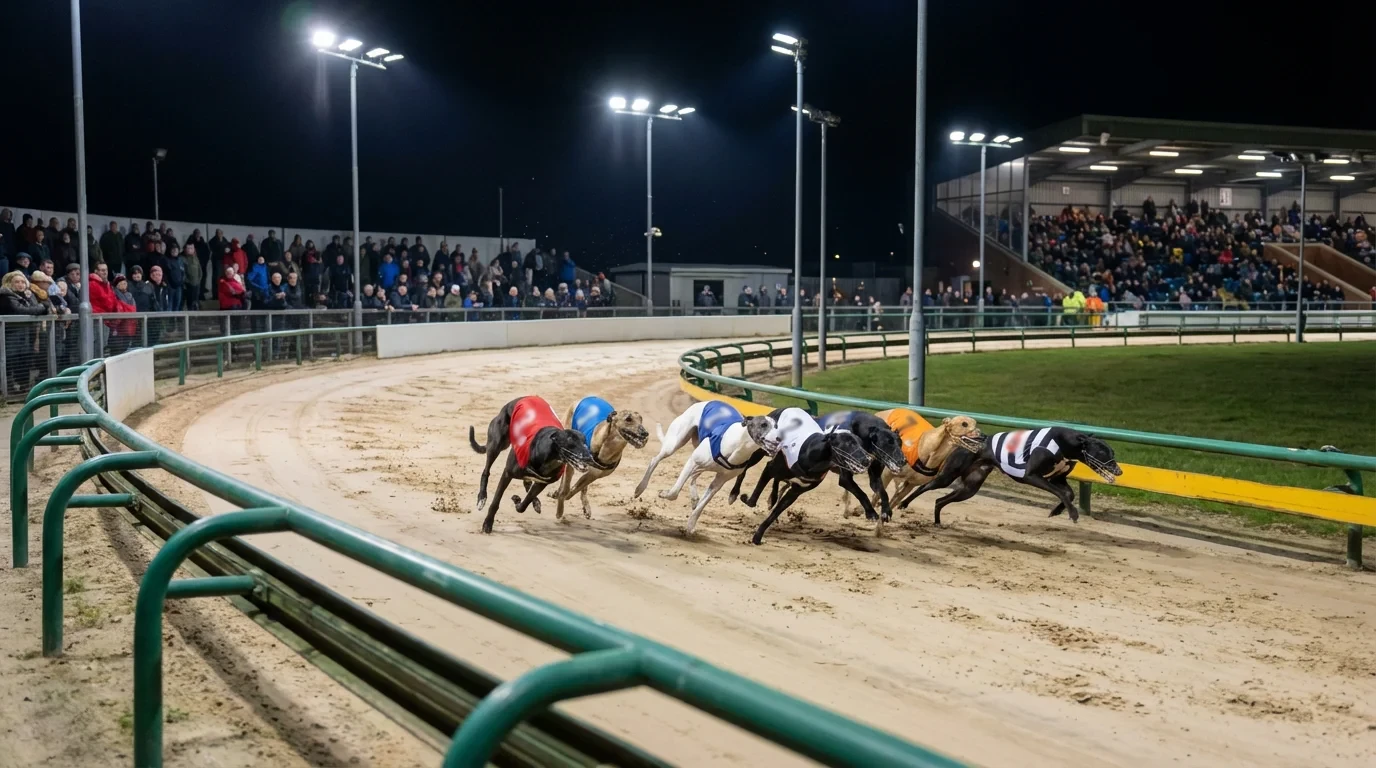
Same Track, Different Sport
On any given evening at a UK greyhound stadium, the card might contain ten graded races and two open races. To the casual observer, they look identical — six dogs, six traps, one mechanical hare, 30 seconds of action. To anyone who studies form, they are fundamentally different contests governed by different rules, different draw mechanics, and different analytical frameworks. Treating them the same way is one of the fastest routes to losing money in greyhound betting.
Graded races are the structured backbone of UK greyhound racing. Dogs are matched by ability, seeded by running line, and placed into fields designed to be competitive within a narrow class band. Open races sit above this structure entirely. They are invitation-only or qualification-based events where the best dogs from multiple tracks converge for higher prize money, and the draw is typically random. The predictability that makes graded racing tractable for form students is stripped away in open company, replaced by chaos, quality compression, and the kind of uncertainty that bookmakers price cautiously and punters often misjudge.
Learn how the grading system works in greyhound grading system.
What Makes a Race Graded
A graded race is assembled by the Racing Manager at a GBGB-licensed track. The manager takes the pool of dogs available that week, sorts them by their current grade (A1 through D4 or equivalent at that venue), and builds races where every runner sits within the same class band. A B2 race contains dogs graded B2 at that track over that distance. The field should be competitive, with no single runner dramatically outclassing the rest.
The seeding process adds a further layer of structure. In graded races, each dog is placed in a trap that reflects its running line. Railers go to the inside traps, wide runners to the outside, and middle runners occupy the centre. This means the draw works with each dog’s natural style rather than against it, which reduces interference and produces cleaner racing. The grading and seeding together create a controlled environment where form is relatively stable and past performances are a reasonable guide to future results.
This control is precisely what makes graded racing attractive to punters. You can look at a B2 racecard, compare six dogs that have all been running in B1 to B3 races at the same track for the last several weeks, and draw meaningful conclusions from their split times, grade movement, remarks, and trap history. The variables are contained. The data is comparable. The racecard is, in effect, a structured dataset that rewards careful reading.
The downside of graded racing from a betting perspective is compressed odds. Because the Racing Manager assembles competitive fields, clear standouts are rare. The favourite in a graded race is often 2/1 or shorter, and the margin between the market leader and the outsider of the field may be only four or five points. Finding genuine value in a race where six closely matched dogs are fairly priced requires precision — not just identifying the likely winner, but identifying when the market has underestimated a specific runner relative to its actual chance.
Open Race Categories 1 to 3
Open races operate outside the grading system. Instead of a Racing Manager assembling a field from the local population, open events draw dogs from across multiple tracks. Entry is by invitation, nomination, or qualification through competition rounds — heats, quarter-finals, semi-finals, and a final. The dog’s grade at its home track is irrelevant; what matters is its ability to compete at open level.
The GBGB classifies open races into three categories. Category One (OR1) events are the highest tier and include the most prestigious competitions in UK greyhound racing: the English Greyhound Derby, the St Leger, the Oaks, and the Champion Stakes, among others (GBGB — Racing). These events carry the largest prize funds, attract the widest media coverage, and produce the most active ante-post betting markets. Category Two (OR2) events are a step below in prestige and prize money but still feature high-quality fields drawn from multiple tracks. Category Three (OR3) events are locally staged opens, typically hosted by individual stadiums, featuring the best dogs at that venue plus occasional visitors.
The critical difference for punters is the draw. In open races, trap allocation is usually random — not seeded by running line. A confirmed railer can land trap six. A wide runner can draw trap one. This randomness introduces a variable that does not exist in graded racing and can override even significant ability advantages. A dog that would win comfortably from its preferred trap may struggle badly from a draw that contradicts its natural style. The draw is the great equaliser in open racing, and it is the primary reason why open-race form is harder to interpret and open-race results are harder to predict.
Competition rounds add another layer. Dogs in the semi-final of a Category One event have already proven themselves in the heats, so the field quality is tightly compressed. The difference between the best and worst dog in a Derby semi-final is far smaller than the difference in a typical graded race. This compression makes betting on open races inherently more volatile — any dog in the field has a genuine chance, and short-priced favourites are less reliable than in graded company.
Betting Approach: Graded vs Open
The analytical framework that works for graded racing does not transfer cleanly to open events. In graded races, you are comparing dogs at the same track, over the same distance, against similar opposition, with seeded draws. Form is stable, and patterns are identifiable. In open races, you are comparing dogs from different tracks, different grading systems, different surface conditions, and random draws. The data is noisier, the patterns are weaker, and the margin for error in your selections is wider.
For graded races, the approach is systematic. Compare split times across the six runners. Assess the draw relative to each dog’s running line. Check grade movement for class droppers or recently promoted runners. Read the remarks column for interference excuses. Identify the dog most likely to lead at the first bend from today’s trap. This process is repeatable and, over a large sample, profitable if executed with discipline.
For open races, shift the emphasis. The draw becomes the dominant variable. Before assessing form, check whether each dog’s running line matches its trap. A railer in trap one or two is in the same position as in a graded race. A railer in trap five is at a significant disadvantage regardless of its form. Then assess which dogs have shown adaptability — runners that have won from different traps in the past, or dogs that have competed in open company before and handled the pressure of an unseeded draw. Experience at open level is itself a form indicator that does not appear on the standard graded racecard.
Staking should differ too. The higher variance in open races means that even well-analysed selections will lose more frequently than in graded company. Reduce your stakes on open-race bets relative to graded-race bets, or focus your open-race betting on each way and forecast markets where the volatility can work in your favour rather than against it.
Two Sports, One Track
Graded and open racing share a track, a set of traps, and a hare. Beyond that, they are meaningfully different contests that demand different preparation from punters. The punter who applies graded-racing logic to an open event — backing the form horse without checking the draw, assuming consistency from a dog stepping up in class, trusting split-time comparisons across different tracks — is betting blind. The punter who adjusts their framework, respects the draw, accounts for quality compression, and moderates their stakes is giving themselves a genuine chance.
Neither type of racing is inherently more profitable than the other. Graded racing offers consistency and volume. Open racing offers larger fields of interest, bigger prices, and the occasional dividend that justifies weeks of patient accumulation. The key is recognising which type of race you are looking at before you start your analysis, and applying the right tools to the right contest.
Understand race grades on the greyhoundcardstoday homepage.
