Virtual Greyhound Racing Betting Guide
 Available in US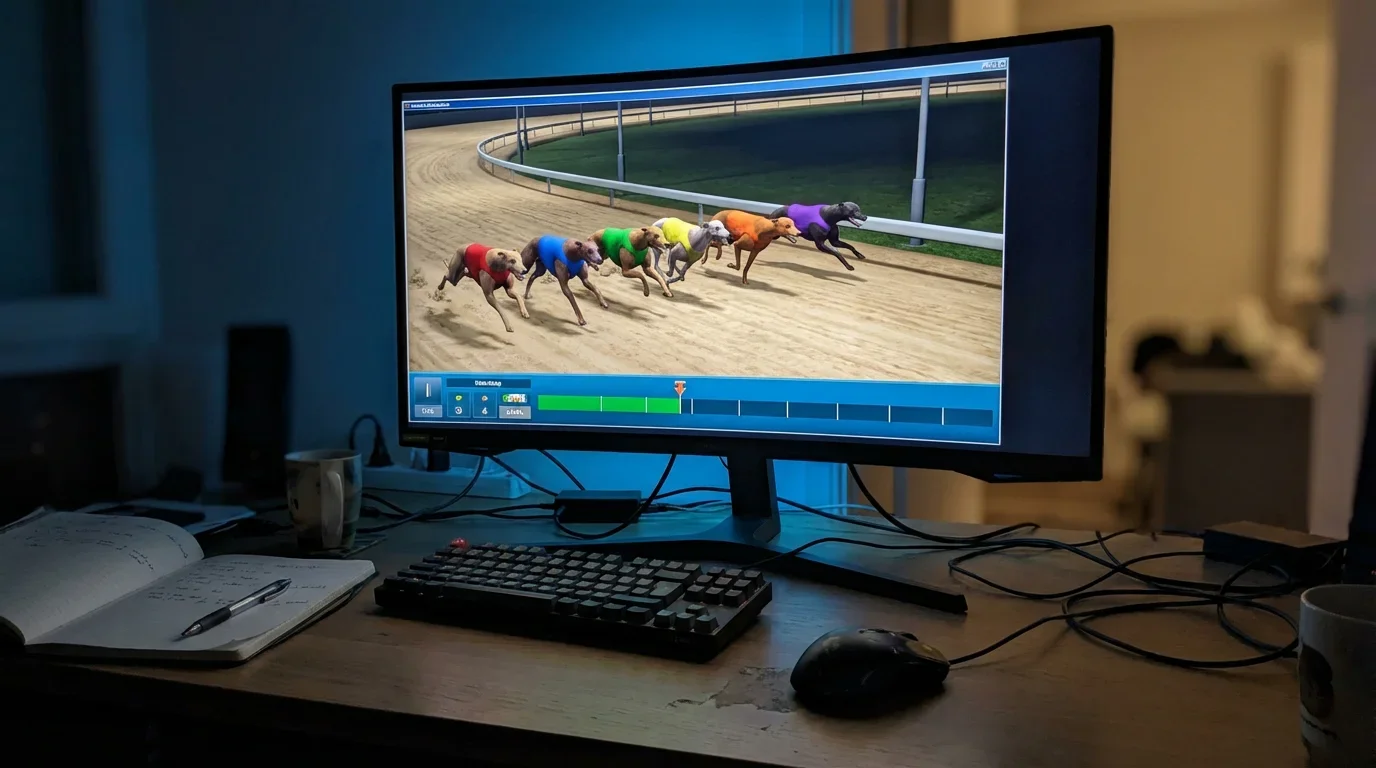
Real Bets, No Dogs
Virtual greyhound racing is a computer-generated simulation that runs 24 hours a day, seven days a week, across almost every UK-licensed online bookmaker. There are no real dogs, no real tracks, and no real form. A new race starts every few minutes. The outcome is determined by a random number generator, the odds are set by an algorithm, and the entire event — from trap draw to finish — is produced by software that renders animated greyhounds on a virtual track.
It exists because bookmakers need product to fill the gaps between real racing, and punters want something to bet on at 3am on a Wednesday. Virtual greyhounds serve that demand. They are available around the clock, they require no form study, and they produce a result within ninety seconds of the previous one. For bookmakers, they are a high-margin, low-cost product. For punters, they are a fundamentally different proposition from betting on real greyhound racing — and understanding that difference is essential before you put money on them.
Compare virtual racing with BAGS racing in what is BAGS.
How Virtual Greyhound Racing Works
A virtual greyhound race is generated by software. The process begins with the algorithm assigning each of the six runners a probability of winning, placing, and finishing in each position. These probabilities are then expressed as odds and displayed on the virtual racecard. The algorithm runs the race — determining the outcome according to the pre-set probabilities — and the result is rendered as a short animation showing six computer-generated dogs racing around a virtual track.
The animation is cosmetic. It exists to give the bettor something to watch, but the visual representation has no influence on the outcome. The result is decided the moment the race is generated. Whether the animated dog appears to show early speed, run wide, or get crowded is irrelevant — these are graphical effects layered onto a pre-determined result. No amount of watching the animation will reveal patterns, because there are no patterns. Each race is an independent random event.
The odds on virtual greyhound races are generated by the same system that determines the result. They reflect the probabilities assigned by the algorithm and include a built-in margin for the bookmaker. The overround — the bookmaker’s profit margin expressed through the odds — on virtual racing is typically higher than on real racing. Where a competitive real greyhound market might operate at a 115 to 120% book, virtual markets can run at 130% or more. This means the punter is paying a higher price for every bet, and the long-term expected loss is correspondingly greater.
Races are generated continuously. A new virtual greyhound event starts every three to five minutes on most platforms, meaning you can place and settle a bet within a few minutes at any time of day. The speed and availability are the product’s selling point — and its primary risk, because the rapid cycle encourages frequent betting in a way that real racing, with its natural gaps between events, does not.
RNG vs Real-World Form
The fundamental distinction between virtual and real greyhound racing is the role of information. In real racing, information is everything. The racecard provides data — form, times, draw, split, grade, remarks, trainer, weight, season date — that allows a skilled punter to assess each dog’s chances and find situations where the odds do not reflect the true probability. That information edge is the entire basis of profitable real-world greyhound betting.
In virtual racing, there is no information edge. The outcome is generated by a random number generator (RNG) that produces each result independently. There is no form to study, no draw advantage to exploit, no trainer pattern to identify, and no interference to excuse. The dog named “Trap 1 Runner” in race 47 has no connection to “Trap 1 Runner” in race 48. Each race is a clean reset with probabilities defined by the algorithm, not by any accumulation of past performance.
This means that no strategy, no system, and no pattern of selections can produce a long-term edge on virtual greyhound racing. The probabilities are fixed by the algorithm, the odds include a margin that favours the bookmaker, and the RNG ensures that results are genuinely random within those probabilities. Over a large sample of bets, the punter’s return will converge on the expected value dictated by the overround — which is a loss. The house edge is structural and cannot be overcome by skill.
Some punters believe they can spot patterns in virtual racing — a specific trap winning more often, or a price range that seems to hit regularly. These perceptions are the product of small sample sizes and confirmation bias, not genuine statistical anomalies. RNG-based systems are audited and certified to produce outcomes that match the declared probabilities. If trap one wins 18% of the time over a million races, that is because the algorithm assigns it approximately that probability — not because of any exploitable bias.
Betting Markets on Virtual Dogs
Virtual greyhound markets are simpler than their real-world counterparts. The standard bet types are available — win, each way, forecast, tricast — but the market depth is thinner and the odds are less negotiable. You take the price that the algorithm offers, and that price already includes a wider margin than you would find on a real race.
Win bets are the most common market. The favourite in a virtual race typically sits between 2/1 and 3/1, with the outsider between 8/1 and 14/1. Each way terms follow the same structure as real racing: one-quarter the odds for two places in a six-runner field. Forecasts and tricasts are available and pay according to a formula similar to the real CSF system, but the dividends tend to be lower because the built-in probabilities are designed to produce a sustainable margin for the operator.
There is no starting price mechanism on virtual races, because there is no market. The odds shown at the time of the bet are the odds you get. There is no Best Odds Guaranteed, no price movement, and no possibility of a drift working in your favour. The price is fixed, the margin is fixed, and the only variable is the outcome — which is random.
Staking discipline matters more on virtual racing than on real racing, precisely because there is no skill component to mitigate the house edge. Every bet placed on a virtual greyhound is a negative-expectation wager. That does not make it morally wrong or irrational as entertainment — plenty of people bet on roulette and enjoy it. But it means that bankroll management and session limits are the only tools available to control losses. The responsible gambling tools built into every UK-licensed bookmaker — deposit limits, session timers, reality checks — are especially important for virtual racing, where the rapid cycle and constant availability can erode a bankroll faster than any BAGS card.
Virtual Racing, Real Money
Virtual greyhound racing fills a specific niche: instant, available, low-effort betting for moments when real racing is not running and the urge to place a bet is present. It is not a substitute for real greyhound racing in any analytical sense. There is no form to study, no skill to develop, and no long-term edge to find. The product is entertainment, priced accordingly, with a house advantage that no strategy can erode.
If you choose to bet on virtual greyhounds, treat it for what it is. Set a session budget. Use the bookmaker’s deposit and loss limits. Do not carry staking patterns or analytical habits from real racing into the virtual environment, because they have no application there. And when the real BAGS card starts at 10:30am, switch over. That is where the racecard matters, the form matters, and the homework pays.
Explore virtual greyhound racing on the greyhoundcardstoday homepage.
