What Is BAGS Greyhound Racing?
 Available in US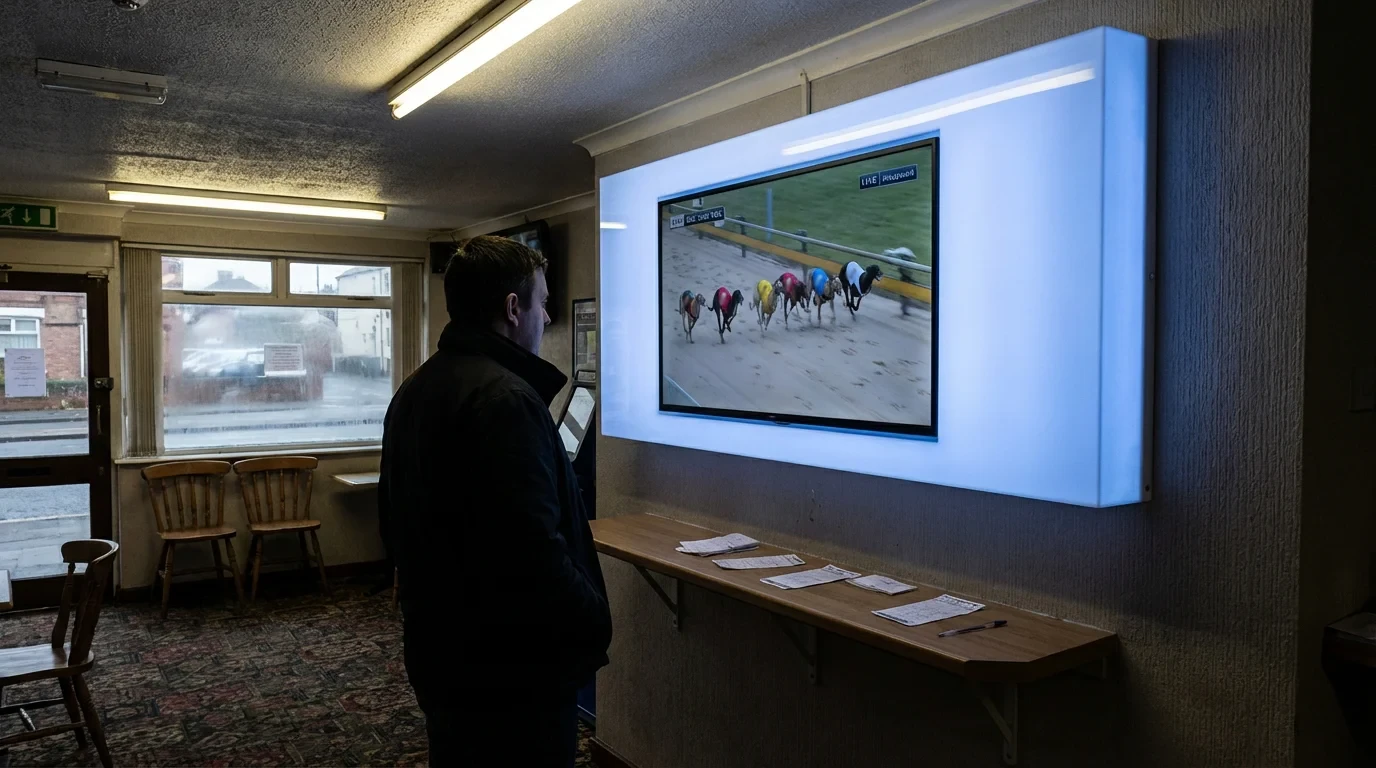
BAGS: The Engine Behind Daytime Dog Racing
If there is a greyhound race on a betting shop screen before 6pm, it is BAGS. The Bookmakers Afternoon Greyhound Service is the infrastructure that turns daytime greyhound racing into a constant, accessible betting product across the United Kingdom. It is not a league, not a competition, and not a brand in any consumer-facing sense. It is a scheduling and broadcast framework — and it is responsible for the vast majority of greyhound bets placed in the UK on any given day.
BAGS exists because bookmakers need product to fill the hours between the morning and evening. Horse racing covers some of that gap, but it does not run continuously, and cards are weather-dependent. Greyhound racing, staged on all-weather sand tracks under predictable conditions, fills the dead spots. A BAGS meeting can begin at 10am and run a race every 15 minutes until mid-afternoon. Another set of meetings picks up in the early evening. Between them, punters in betting shops and online have a near-constant stream of short, sharp events to bet on.
The service operates through a commercial agreement between the tracks, the bookmakers, and SIS (Sports Information Services), which handles the broadcast and data feeds. SIS distributes live pictures and betting data from BAGS meetings to thousands of betting shops and online platforms. Without this infrastructure, daytime greyhound racing would exist only for the few hundred spectators at each track. With it, every afternoon meeting is a nationwide betting event.
For punters, the practical takeaway is straightforward: BAGS is where most of your greyhound betting opportunities come from. Understanding what it is, how its schedule works, and how its racing quality compares to evening and open events will sharpen the way you approach the racecard.
See all UK tracks and fixtures in UK greyhound tracks fixtures.
How the BAGS Schedule Works
BAGS is a schedule, a broadcast deal and a betting product rolled into one. The mechanics are simple but worth understanding, because they dictate which tracks you will see on any given day and when.
A rotating roster of GBGB-licensed tracks contributes meetings to the BAGS schedule. Not every track runs BAGS every day — meetings are allocated by agreement, and the rotation ensures a spread of fixtures across the week. On a typical weekday, you might see two or three BAGS meetings running simultaneously, staggered so that races do not overlap. One meeting might start at 10:30am, another at 11am, a third at 11:15am, with races at each venue spaced roughly 15 to 18 minutes apart. This staggering is deliberate: it gives betting shop customers a race to watch every few minutes without any dead time.
The tracks that regularly contribute to BAGS include many of the GBGB’s licensed stadiums. Central Park, Monmore, Doncaster, Sheffield, Swindon, Yarmouth, Harlow, Henlow, and Sittingbourne are among the most frequent contributors to the daytime schedule. The specific rota changes periodically, and tracks may swap days or take weeks off, so the fixture list is never static. This is why checking today’s BAGS schedule before betting is not optional — it is essential.
SIS handles the technical side. Live video, race data, starting prices and results are all transmitted from trackside to betting platforms in real time. The feed appears in betting shops on dedicated screens, and online bookmakers embed the same data into their greyhound sections. When you open a bookmaker app and see a racecard for a 1:17pm at Monmore, you are looking at a BAGS meeting delivered by SIS.
The evening equivalent is BEGS — the Bookmakers Evening Greyhound Service. The same principle applies, but for meetings staged after the afternoon sessions. Evening BAGS (or BEGS) meetings tend to overlap with tracks that also stage their own evening events with spectator attendance, so the distinction between a BEGS broadcast meeting and a regular evening meeting can blur. Premier Greyhound Racing events, backed by Sky Sports Racing, occupy a different tier entirely.
BAGS Racing vs Open and Premier Racing
BAGS dogs are workers. Open-race dogs are athletes. Your betting approach should differ accordingly.
The fundamental distinction is quality. BAGS meetings are graded racing — bread-and-butter fixtures where dogs are matched into races based on their recent form and grade classification. The fields are competitive within their class, but the class itself is typically mid-range. You are not watching Category One greyhounds at a BAGS meeting. You are watching honest, workmanlike dogs running regularly at their local track, graded into races that the Racing Manager has assembled to produce close, competitive contests.
Open racing is a different sport. Open events — particularly Category One and Two competitions — feature the best dogs from multiple tracks, drawn together for higher prize money and greater prestige. The English Greyhound Derby, the St Leger, the Oaks, and dozens of other named competitions sit above the graded system. Dogs entered in opens are not matched by the Racing Manager’s algorithm; they qualify through heats and semi-finals, or are invited based on reputation. The draw in open races is random, not seeded, which creates more chaotic and less predictable racing.
Premier Greyhound Racing events, broadcast on Sky Sports Racing, occupy the top tier of evening televised action. These are the meetings that generate the most media coverage and attract the biggest ante-post betting markets. The dogs are sharper, the times are faster, and the margins between first and last are often narrower than in graded BAGS racing.
For your betting, the distinction matters in three ways. First, BAGS form is more consistent. Dogs race at the same track, over the same distances, against similarly graded opponents. Form lines are easier to compare, and patterns are easier to spot. Second, BAGS fields are more predictable. The grading system ensures that mismatches are rare — you will not often find a dog five grades above the rest of the field. This makes it harder to find standout winners, but easier to assess the relative chances of each runner. Third, the betting market on BAGS races is thinner. Fewer punters study daytime greyhound form in depth, which means the odds can be less efficient than in high-profile evening meetings. This is where sharp punters find their edge.
Why BAGS Matters to Your Betting
BAGS is not glamorous, but it is where most greyhound money changes hands. The sheer volume of racing — dozens of meetings per week, hundreds of races — means that BAGS is the default betting product for anyone who takes greyhound punting seriously. It is also the most accessible: you do not need a Sky Sports subscription or a track membership to watch and bet on BAGS racing. A betting shop account or an online bookmaker is all you need.
The frequency is a double-edged sword. On one hand, BAGS gives you a constant stream of opportunities to apply your form analysis. If you have developed a method for reading racecards — assessing trap draw, split times, grade movement, remarks column — then BAGS provides the volume of races needed to test and refine that method over hundreds of data points. On the other hand, the constant availability invites overbetting. A new race every 15 minutes creates the temptation to bet on every race, regardless of whether you have a genuine edge. Discipline is the separator.
Approach BAGS cards differently from evening meetings. The dogs are less talented, the fields are less varied, and the form is more cyclical. A dog that has won twice in its last three runs at a BAGS meeting is likely to be competing against similar opposition to the last time. That consistency is your friend — it makes the form more reliable and the racecard more predictive. But it also means that value is found in the margins: a slight grade drop, a favourable trap switch, a first run back after a short break at a track where the dog has a strong record.
The Daytime Grind
Nobody glamorises a 1:17pm race at Monmore. There are no television pundits previewing the card, no ante-post markets weeks in advance, no trophy presentations. It is six dogs, a sand track, and a mechanical hare — repeated twelve times across a Tuesday afternoon. And yet somebody is cashing a ticket at almost every meeting.
The punters who profit from BAGS racing tend to share a profile: methodical, patient, selective. They do not bet every race. They study the card, identify one or two races where the form points clearly to a runner with a strong chance at a fair price, and leave the rest alone. They treat BAGS not as entertainment but as a structured, repeatable process. The track runs every week. The dogs come back in the same grades. The data accumulates. And over time, disciplined card-reading on BAGS meetings produces steadier returns than chasing big prices at high-profile evening events.
BAGS is the foundation of UK greyhound betting. It does not demand inspiration — it rewards consistency.
Learn about BAGS greyhound racing on the greyhoundcardstoday homepage.
