Greyhound Track Bias — How to Spot It
 Available in US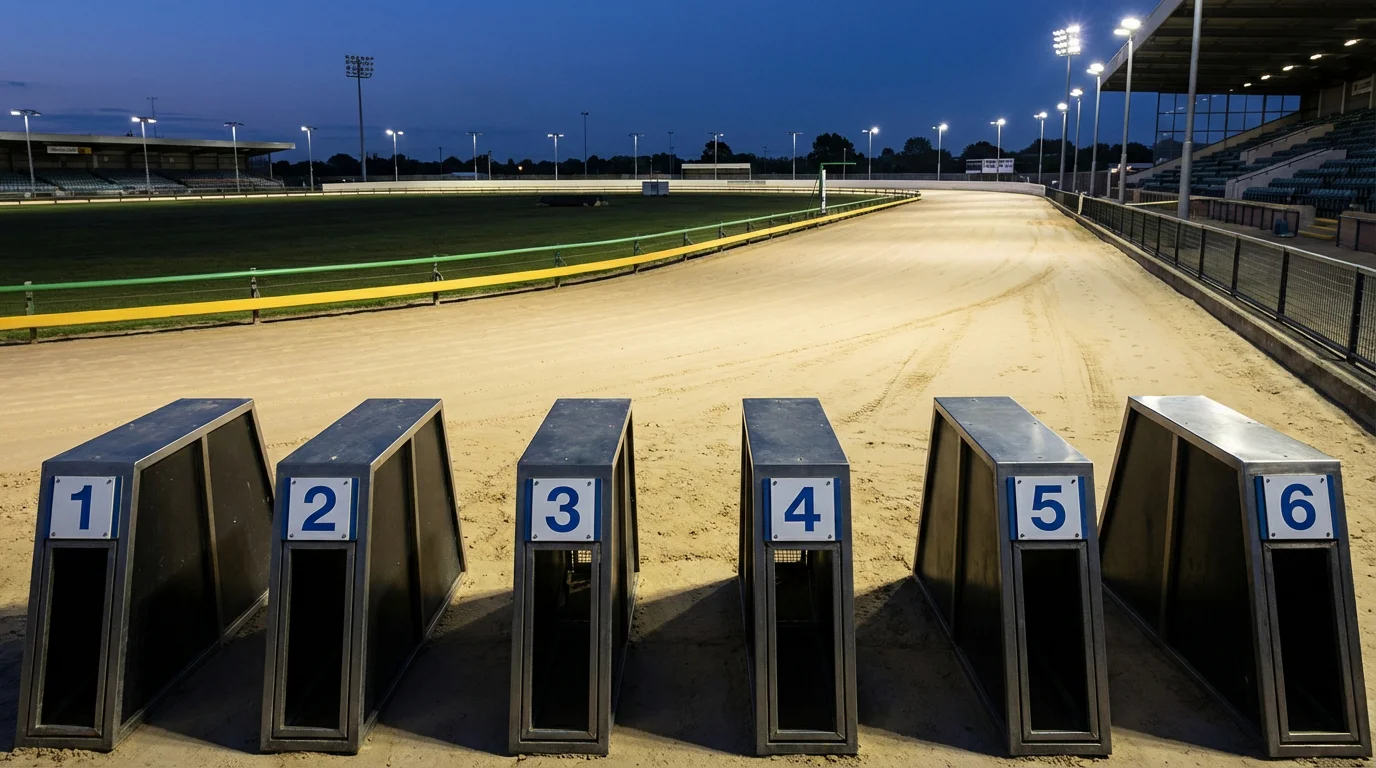
When the Track Picks the Winner
Track bias in greyhound racing is the tendency for certain trap positions to produce a disproportionate number of winners at a given track. It is not a conspiracy and it is not a flaw — it is geometry. Every greyhound track has a unique physical layout: the distance from the traps to the first bend, the tightness of the bends, the width of the track, the camber of the surface, the position of the hare rail. These physical characteristics create conditions that favour some starting positions over others, and the data confirms it. At most UK tracks, the win distribution across six traps is not even. Some traps win significantly more often than the random expectation of 16.7%.
For punters, track bias is an edge hiding in plain sight. It does not replace form analysis — a badly drawn dog with superior ability can still win — but it adds a systematic tilt to the probabilities that, over hundreds of bets, compounds into measurable value. The punter who knows that trap one at a specific track wins 22% of races over 480 metres is making decisions with better data than the punter who assumes all traps are equal.
See how bias affects running lines in trap draw running lines.
What Trap Bias Means in Practice
Trap bias arises from the interaction between track geometry and the physics of greyhound racing. The most common source is the first bend. When the distance from the traps to the first bend is short, inside traps have a structural advantage: they reach the bend first because they are physically closer, and once they hold the rail, they run the shortest route around the turn. The shorter the run-in, the greater this advantage, because there is less time for outside runners to compensate with superior speed.
Conversely, tracks with a long run to the first bend reduce inside-trap bias. The extra distance gives all six dogs more time to reach racing speed and sort themselves by pace rather than by starting position. On these tracks, early speed matters more than trap number, and the bias — if it exists — tends to favour whichever trap range typically houses the fastest early-pace dogs (often traps one and two, because railers with quick splits tend to be seeded there).
Bend tightness matters too. A tight first bend amplifies inside-trap advantage because the angle is sharper, the inside line is significantly shorter, and the congestion on the outside is more severe. A sweeping bend spreads the field and gives wide runners more room to hold their line without losing excessive ground. Track width has a similar effect: narrow tracks compress the field, benefiting inside runners; wider tracks give the outside traps more breathing space.
The run-in after the last bend — the home straight — introduces a secondary bias. A long run-in favours closers and wide runners who have room to make up ground on the straight. A short run-in favours front-runners who established their lead at the bends and do not need to sustain it for long. This affects the overall trap bias because front-runners are more commonly seeded in inside traps.
Weather and surface conditions can modify bias temporarily. A rain-soaked track may play differently from a dry one. The inside rail, which takes the most traffic, can become chewed up over the course of a meeting, reducing the advantage of running close to it. Some regular punters track how bias shifts between dry and wet cards at their preferred venues — a refinement that takes months of data collection but produces genuinely actionable information.
Tracks with Known Biases
Every GBGB-licensed track has its own bias profile, and while the specifics change over time — track resurfacing, hare rail adjustments, or layout modifications can all shift the pattern — certain tendencies are well established within the greyhound punting community.
Tracks with short runs to the first bend tend to produce the most pronounced inside-trap biases. At these venues, trap one and trap two consistently outperform the statistical expectation, sometimes by five or more percentage points. The advantage is most visible over sprint distances, where the race is effectively decided by the first bend, and less pronounced over middle and staying distances where the extra bends and longer run-in give outside runners more opportunity to recover.
Tracks with wider circuits and longer straights tend to produce a flatter bias distribution. At these venues, the difference in win rate between trap one and trap six may be only two or three percentage points — still present, but less dramatic. Wide-running dogs and closers have a fairer chance at these tracks, which makes form and pace analysis relatively more important than raw draw position.
Some tracks have historically favoured specific outside traps at certain distances. This can occur when the run to the first bend includes a slight curve or when the hare rail position creates a sightline advantage for dogs in wider traps. These are track-specific quirks that only become apparent through sustained data collection, and they are among the most valuable biases to identify because the market is less likely to have priced them in.
The best source of trap-bias data is your own results tracking, supplemented by statistics published on specialist form sites. Timeform (Timeform Greyhounds) and some independent analysts publish trap statistics for individual tracks on a rolling basis. These figures give you a starting point, but they are backward-looking and may not reflect recent changes to the track surface or layout. Cross-reference published statistics with your own observations over the most recent four to six weeks for the most current picture.
Incorporating Bias Into Selections
Track bias is not a selection method in itself. It is a modifier — an additional factor that adjusts the probability you assign to each runner based on its trap position. The core of your assessment should remain the dog’s form, pace, running line, and the specific opposition it faces. Track bias tilts the picture, sometimes slightly, sometimes significantly.
The practical application is straightforward. When two dogs in a race have similar form and are both well drawn for their running lines, check the track’s trap bias. If one is drawn in the statistically favoured trap and the other is not, give the favourably drawn runner the edge. When the market prices two dogs equally but the trap bias clearly favours one, you have found a discrepancy worth backing.
The trap-bias edge is strongest in competitive graded races where the form is tightly compressed and the difference between the six runners is marginal. In those races, small advantages compound: the dog with slightly faster splits, in the trap with a historical bias, trained by a kennel in form at this track, is accumulating overlapping edges that the market may not fully aggregate. Individually, each factor is a whisper. Together, they form a case.
Geometry Is Not Destiny
Track bias tells you what the track favours, not what will happen. A dog in a statistically disadvantaged trap can still win if it is fast enough, clean enough through the bends, and good enough to overcome the geometry. Bias is a probability shift, not a guarantee. Over a hundred races, it moves the win distribution by a few percentage points — enough to generate profit at level stakes, not enough to turn every race into a certainty.
Use it as one input among many. Know the bias profile of the tracks you bet on. Factor it into your assessments. But do not let it override clear form evidence. A demonstrably superior dog from a weak trap is still more likely to win than a moderate dog from a strong trap. Bias rewards the disciplined user — the punter who applies it to marginal decisions, not the one who bets on trap one in every race because the statistics say it wins more often.
Analyse track bias on the greyhoundcardstoday homepage.
