Greyhound Racing vs Horse Racing Betting
 Available in US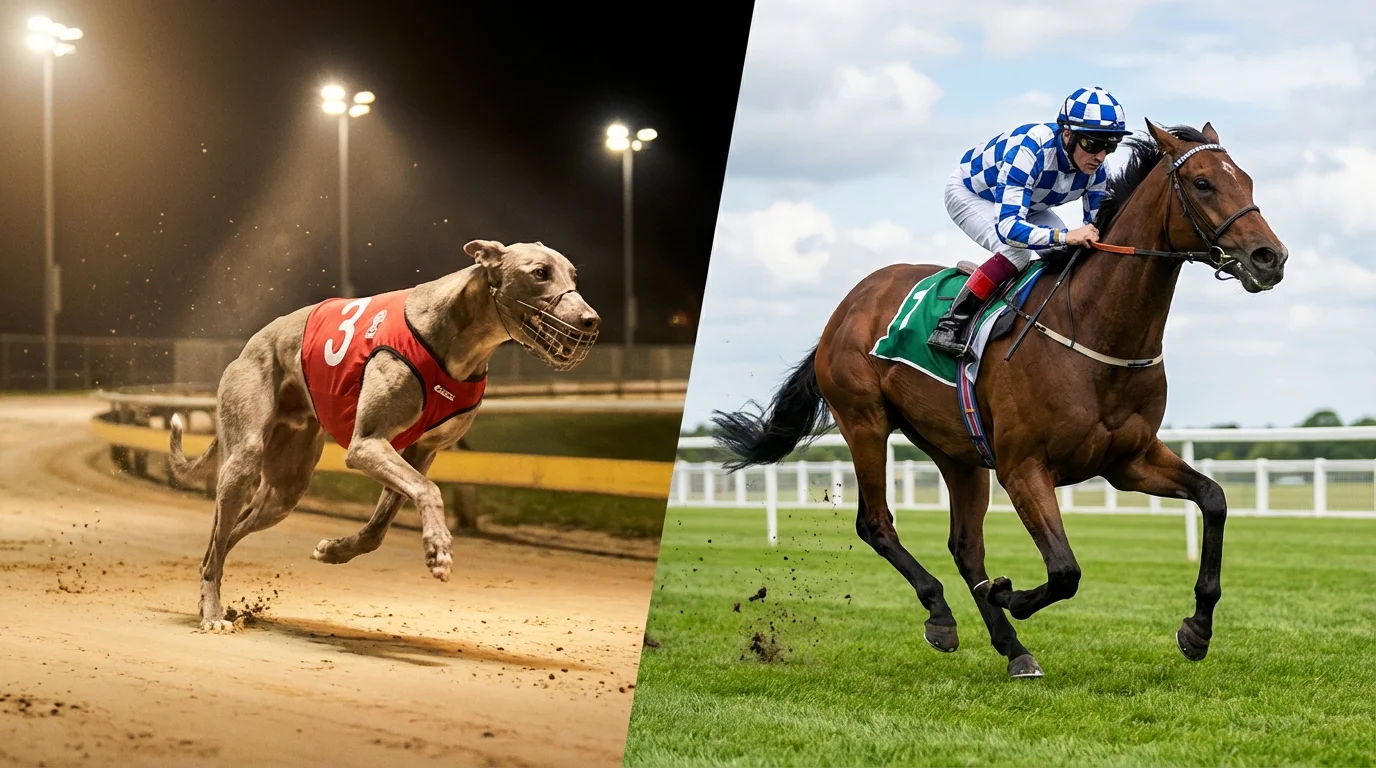
Two Codes, Two Mindsets
Most UK punters come to greyhound racing from horse racing. The transition feels natural — both involve animals racing around a track, both have racecards with form data, both offer win, each way, forecast and tricast markets. But beneath the surface similarities, the two sports operate on fundamentally different principles, and the punter who carries horse racing habits into greyhound betting without adjustment will make avoidable mistakes. The fields are smaller. The variables are fewer but sharper. The form is more cyclical. The markets are thinner. And the pace of the product — a race every 15 minutes across multiple meetings — creates a tempo that horse racing, with its longer gaps and fewer daily fixtures, does not match.
Understanding these differences is not about declaring one code superior. It is about calibrating your approach. The analytical toolkit that works on a Saturday afternoon at Cheltenham is not the same toolkit that works on a Tuesday lunchtime BAGS card at Monmore. Both reward study, but they reward different kinds of study.
Learn the basics of greyhound betting in how to bet on online.
Field Size and Variables
The most obvious structural difference is field size. Greyhound races have six runners. Horse races range from five to more than twenty. This single variable cascades through every aspect of the betting experience.
In a six-runner greyhound race, the baseline random win probability for each dog is approximately 17%. In a 16-runner handicap hurdle, it is 6%. This means the theoretical favourite in a greyhound race is far more likely to win than the theoretical favourite in a large horse racing field. Greyhound favourites win roughly 33% of the time. Horse racing favourites in large fields win around 25 to 30%. The shorter-priced, higher-frequency nature of greyhound betting creates a different risk profile: steadier returns but smaller margins for profit.
The smaller field also reduces the number of variables in play. In horse racing, you are assessing the jockey, the trainer, the going, the distance, the weight carried, the draw, the pace scenario, the trip in running, and the horse’s physical and mental state — across a dozen or more runners. In greyhound racing, there is no jockey variable, no weight variable, and the going adjustment is standardised through the calculated time system. The primary variables are the trap draw, the running line, the early speed, the grade, and the form. Fewer variables means fewer unknowns, which makes greyhound form more transparent — but also makes it harder to find an edge, because everyone else has access to the same simplified data.
The draw in greyhound racing is dramatically more influential than in horse racing. In a flat race at Ascot, the draw may matter at certain distances on certain going, but it is one factor among many. In a greyhound race, the trap draw interacts with the dog’s running line and the track’s bias to produce a positional advantage or disadvantage that can override everything else. A punter who dismisses draw analysis in greyhound racing the way they might in a two-mile chase is missing the most important variable on the card.
Form Reliability Comparison
Greyhound form is, on balance, more reliable than horse racing form — within its own context. The reasons are structural. Greyhound races are run on all-weather sand tracks under controlled conditions. The going is measured and adjusted for. The dogs race frequently — sometimes weekly — at the same track, over the same distance, against similarly graded opposition. This consistency produces form lines that are directly comparable from one run to the next.
Horse racing form is noisier. Horses race on different tracks, on turf that changes with the weather, over distances that vary by furlongs, carrying different weights, ridden by different jockeys with different tactical instructions. A horse’s form at Kempton on the all-weather tells you relatively little about its chances at Haydock on soft ground. In greyhound racing, a dog’s form at Romford over 400 metres is a strong guide to its next run at Romford over 400 metres, because the conditions are essentially the same.
The flip side is that greyhound form is more cyclical. Dogs move through phases: improving after a grade drop, peaking for a few weeks, then declining as they are promoted beyond their level or as physical condition wanes. The form cycle in greyhound racing is faster and more predictable than in horse racing, where layoffs, seasonal campaigns, and training regimes introduce longer-term variability. A greyhound punter who is good at reading where a dog sits in its form cycle — peaking, declining, or transitioning — has a more repeatable edge than a horse racing punter facing the same question with more variables and less data consistency.
One area where horse racing form is richer is the narrative depth. Horse racing racecards include in-running comments, sectional times over multiple intervals, jockey reports, and post-race analysis. Greyhound racecards are more compressed — the remarks column and split times carry the key data, but the analytical texture is thinner. This means greyhound form assessment is faster but shallower per runner, while horse racing form assessment is deeper but more time-consuming.
Bet Type Differences
The core bet types are shared across both codes: win, each way, forecast, tricast, and accumulators. But the application differs because of the field-size difference.
Each way betting is structurally different in greyhound racing. In a six-runner field, EW covers two places at one-quarter the odds. In horse racing, field-dependent terms mean EW can cover two, three, or four places at one-quarter or one-fifth the odds. The greyhound EW is simpler but less forgiving — with only six runners and two places, there is less cushion for a placed runner to generate profit on the place leg. The mathematical threshold for profitable EW greyhound betting (roughly 4/1 and above) is higher than in large-field horse races where extra places expand the safety net.
Forecast and tricast betting is proportionally more popular in greyhound racing than in horse racing, precisely because the smaller fields make predicting the first two or three home a more tractable problem. Naming the first two in a six-runner race (30 possible combinations for a straight forecast) is a fundamentally different challenge from naming the first two in a 16-runner handicap (240 possible combinations). Greyhound forecasts offer a sweet spot between difficulty and reward that large horse racing fields cannot match.
Market liquidity is the final difference. Horse racing betting markets are deep, competitive, and well-analysed. Greyhound markets, particularly on daytime BAGS meetings, are thinner. Fewer punters study greyhound form in depth, which means prices can be less efficient. A well-prepared greyhound punter has a larger potential edge over the market than a well-prepared horse racing punter operating in a more competitive betting environment. The trade-off is that the stakes are lower — bookmakers limit greyhound payouts more aggressively than horse racing payouts, and the maximum stakes accepted on greyhound bets are typically smaller.
Different Animals, Different Instincts
The punter who succeeds at horse racing values complexity. They enjoy the deep dive into sectional analysis, jockey bookings, trainer patterns across a seasonal calendar, and the tactical nuance of a jockey switching to the stands rail at three furlongs out. The punter who succeeds at greyhound racing values clarity. They focus on a smaller set of variables — draw, split, grade, remarks — and apply them with precision across a high volume of races.
Neither approach is inherently more profitable. Horse racing offers bigger fields, richer data, and higher-profile markets. Greyhound racing offers cleaner form, faster turnover, and thinner markets where edges are easier to find but harder to exploit at scale. The best cross-code punters recognise which instincts to carry across and which to leave behind. The draw obsession of a greyhound punter would serve them well on a flat card at Chester. The pace-mapping skills of a horse racing punter would sharpen their first-bend predictions at Romford. Borrow what works. Discard what does not.
Compare greyhound and horse racing on the greyhoundcardstoday homepage.
