Greyhound Racing Results and How to Check Them
 Available in US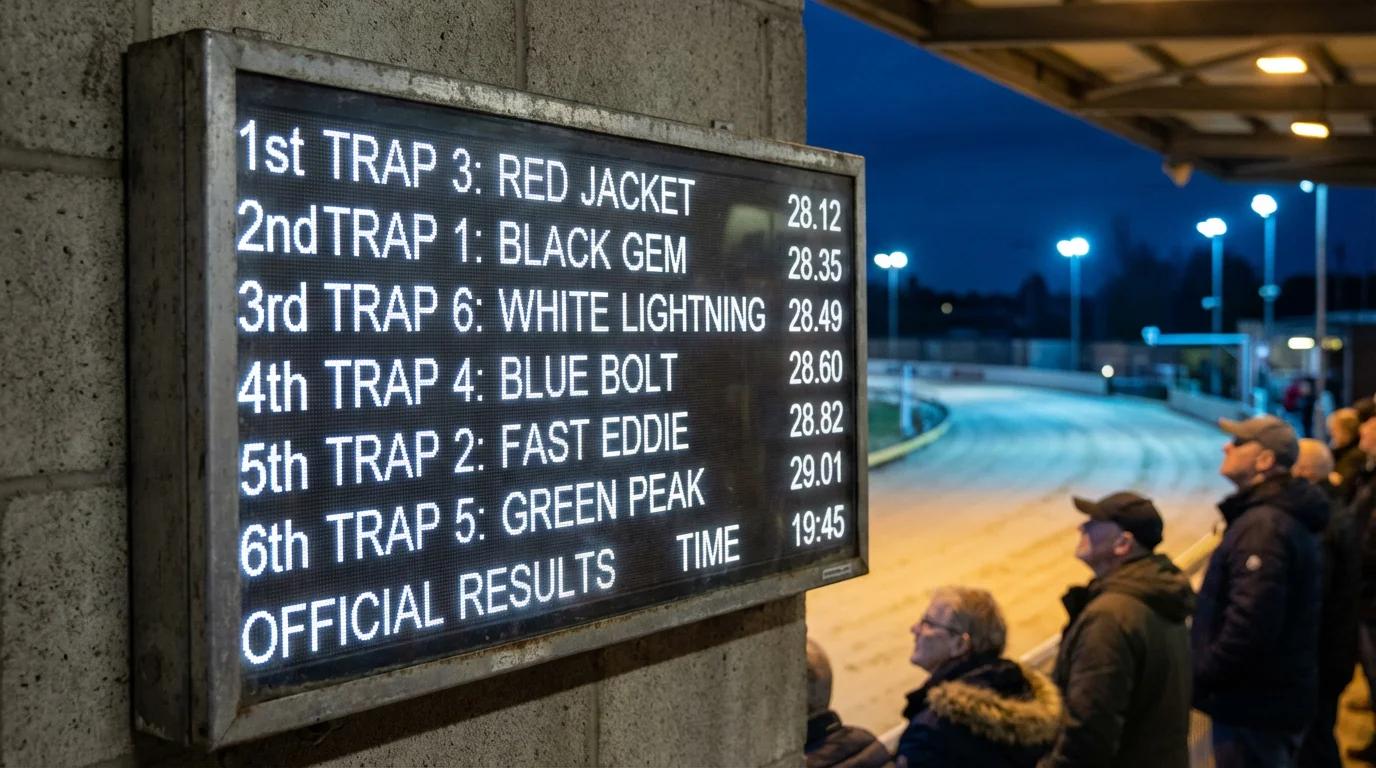
Results Are Not the End — They Are the Beginning
Checking greyhound racing results is the simplest task in the sport. Within minutes of a race finishing, the result is published across dozens of platforms. The winning dog, the finishing order, the distances, the starting prices — all of it appears online faster than you can finish your tea. Yet the way most punters interact with results is superficial. They check whether their bet won. If it did, they move on. If it did not, they move on faster. The result is treated as a conclusion rather than what it actually is: raw material for future betting decisions.
A greyhound result, fully examined, tells you far more than who crossed the line first. It tells you which dogs were unlucky, which were flattered by the draw, which ran faster than the bare form suggests, and which will face different conditions next time. Every result from today’s card is tomorrow’s form line — and the punters who review results with the same attention they give the racecard are the punters who spot value that the market has not yet absorbed.
Check trainer form alongside the results in trainer form and kennel stats.
Fast Results vs Full Results
There are two tiers of greyhound results, and the difference between them matters more than most punters realise.
Fast results are what appear first: the finishing order, the winning time, the starting price of the winner, and the distances between the placed dogs. On a bookmaker app, the fast result typically pops up within a minute of the race finishing. It gives you enough information to settle a bet — the dog won or it did not — but nothing more. You know the outcome. You do not know the story.
Full results appear later, usually within 30 minutes to an hour of the race. They include the complete race data: finishing positions for all six runners, individual times, the going, calculated times, the starting price of every runner, trap positions, and — critically — the remarks for each dog. The remarks are the narrative layer. They record what happened during the race: which dogs showed early pace, which were crowded, which ran wide, which led, which fell or were checked. Without the remarks, a sixth-place finish is a mystery. With them, it is either a bad run or a run destroyed by circumstances.
Full results also include the split times for each runner, the bend positions (where each dog was placed at each bend), and the official Computer Straight Forecast and tricast dividends. This supplementary data is what transforms a bare result into actionable intelligence. If you are serious about greyhound betting, your results review should wait for the full data rather than reacting to the fast result alone.
Where to Find Results Online
Greyhound results are available across a range of platforms, each with different levels of detail and speed of publication.
Bookmaker websites and apps publish fast results almost instantly. If you have an account with any major UK-licensed bookmaker, navigating to the greyhound section and selecting the completed meeting will show you the result of every race on that card. The data is typically limited to finishing order, winning time, and starting prices. It is useful for settling bets and getting a quick overview, but it lacks the depth needed for form analysis.
Specialist form sites provide full results with the complete data set. Timeform (Timeform Greyhounds) publishes detailed results including calculated times, sectional data, and race commentary. The Racing Post’s greyhound section carries full results with remarks, form lines, and trainer information. Both platforms are the standard references for punters who want to analyse results rather than merely note them. Some track websites also publish their own results, often including downloadable PDFs of the full card with remarks — a format that is particularly useful for archiving and offline review.
RPGTV broadcasts results as part of its live coverage, and race replays are often available through the channel’s website or via bookmaker replay libraries. Watching the replay alongside the written result is the most complete way to understand what happened in a race, because it lets you see the incidents that the remarks describe. A remark of “BCrd1” tells you the dog was badly crowded at the first bend. The replay shows you exactly how it happened, which other dogs were involved, and whether the draw was the root cause.
SIS (Sports Information Services), which distributes the live data from BAGS and evening meetings (SIS Racing), provides results to all its commercial partners simultaneously. This means the data is the same across platforms — there is no advantage in checking one bookmaker’s results over another. The difference is in how much supplementary information each platform adds to the base result.
Using Past Results for Future Bets
The real value of results lies not in knowing who won yesterday but in knowing why, and using that knowledge to assess today’s racecard more accurately.
Start with the remarks. After each meeting you have bet on — or plan to bet on next time it runs — review the full results and note which dogs encountered trouble. A dog that finished fifth with “BCrd1, Crd3” (badly crowded first bend, crowded third bend) had a comprehensively disrupted race. If that dog appears on tomorrow’s card from a better draw, the market may still be pricing in yesterday’s poor finishing position without accounting for the interference. You know better, because you checked the full result.
Check the calculated times. Compare the CalcTm of each runner against its previous CalcTm figures. A dog whose CalcTm improved significantly in yesterday’s race is a dog on an upward trajectory — even if it did not win. If it ran a CalcTm two tenths faster than its previous three runs, that improvement is genuine and should carry forward to the next race. Conversely, a dog whose CalcTm slipped without any obvious interference may be losing form, and the result confirms what the numbers suggest.
Track the split times. If a dog showed early pace in yesterday’s result that was not evident in its previous form, something has changed — perhaps a training adjustment, a distance switch, or simply natural improvement. That new early speed will affect the dog’s prospects in future races, particularly if it is drawn favourably next time. The result gave you this information. The racecard for the next meeting will not.
Results review is also the foundation of track-level knowledge. By studying results from a specific venue over several weeks, you develop an understanding of how the track rides: which traps are favoured in different weather conditions, which distances produce the most competitive races, which trainers are in form, and how the going typically varies across a meeting. This accumulated knowledge cannot be gained from looking at today’s racecard in isolation. It can only be built by reviewing yesterday’s results, and the day before that, and the week before that.
Results Build the Picture
A single result is a data point. A hundred results are a picture. The punters who profit from greyhound racing are the ones who collect data points systematically — not just from the races they bet on, but from the track, the trainers, the dogs, and the conditions that produced each result. Over time, that picture becomes detailed enough to reveal patterns that the market misses, and patterns that the market misses are where value lives.
Check your results after every meeting. Read the full data, not just the fast result. Note the remarks, compare the CalcTm, watch the replays when available. It takes twenty minutes per meeting, and it is the single most productive investment of time you can make outside of studying the racecard itself. The racecard tells you what might happen. The results tell you what did happen. Both are essential.
Follow greyhound racing results on the greyhoundcardstoday homepage.
