Greyhound Early Speed and First Bend Theory
 Available in US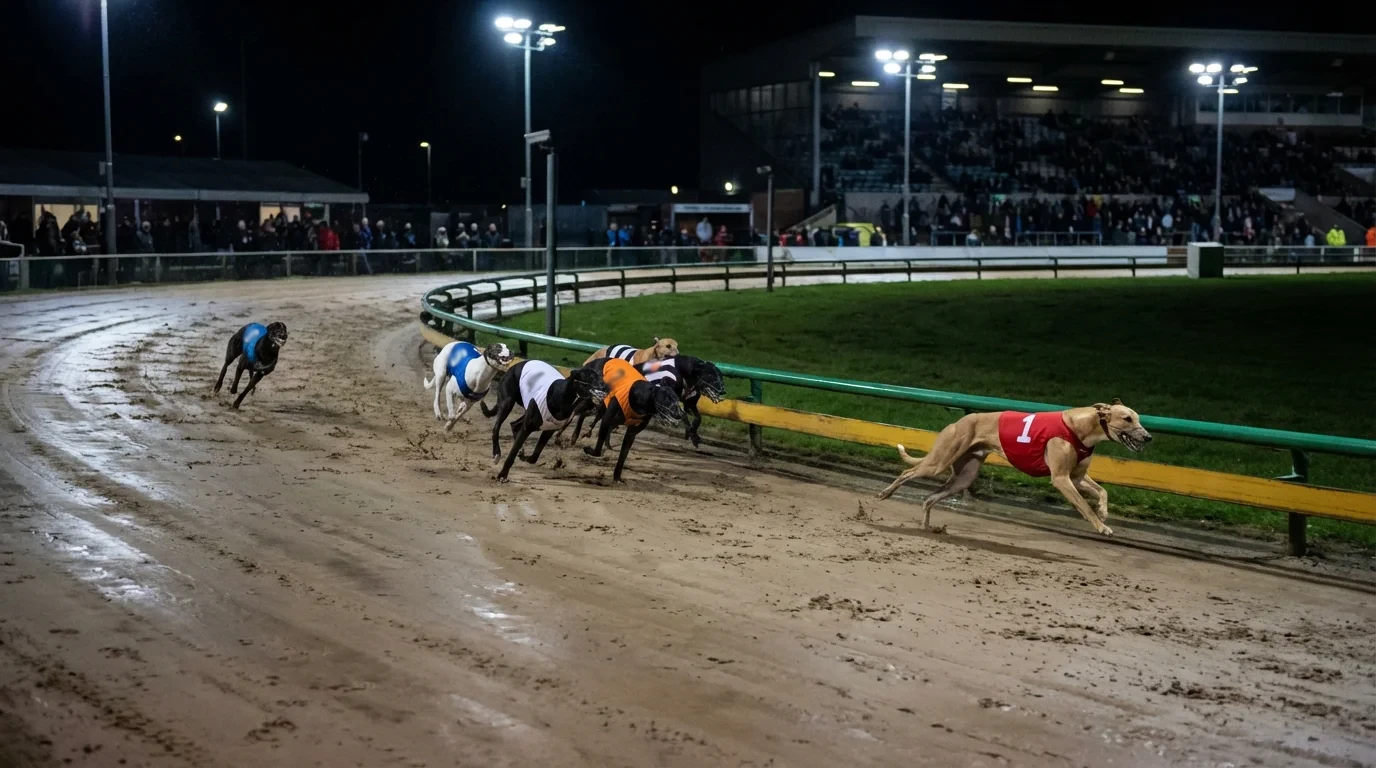
The Race Before the Race
A greyhound race lasts about thirty seconds. The outcome is usually decided in the first four. That is the window between the traps opening and the field reaching the first bend — a compressed, chaotic interval where six dogs accelerate from zero to roughly 40 mph, converge on a single turn, and sort themselves into a running order that, more often than not, holds to the finish line.
Early speed is the attribute that wins this race-before-the-race. Not overall speed, not stamina, not finishing kick. The ability to break fast from the traps, hit racing pace before the opposition, and reach the first bend in a clear forward position. It is the most valuable trait a greyhound can possess in standard four-bend racing, and the racecard gives you the tools to identify it before the traps open.
Yet most punters assess greyhound form by looking at finishing positions and times — metrics that describe the end of the race, not the beginning. The punters who profit consistently tend to work the other way round. They start with the first bend and work backwards to the card.
Combine speed theory with trap draw analysis in trap draw running lines.
Why Early Pace Wins Greyhound Races
The first-bend advantage in greyhound racing is structural, not incidental. It exists because of the track geometry. A standard UK greyhound track is a tight oval with four bends. The bends are sharp relative to the dogs’ speed, and the track is narrow — typically six lanes wide at most. When six dogs running at full speed arrive at the first bend simultaneously, only one or two can take the shortest line. The rest are forced to run wider, check their stride to avoid contact, or lose position entirely as they get squeezed between converging bodies.
The dog that arrives first avoids all of this. It takes the inside line, runs the shortest distance around the bend, and exits onto the back straight with clear air ahead and disrupted rivals behind. This positional advantage compounds through the remaining bends. A dog leading by two lengths at the first bend rarely needs to increase that margin — it simply has to maintain pace while the dogs behind it continue to deal with traffic and lose fractions of a second at each turn.
Statistical analysis of UK greyhound results consistently shows that the dog leading at the first bend wins more than 40% of four-bend races. In a six-runner field with a baseline random expectation of 17%, that is a massive skew. The second dog at the first bend wins roughly 20% of the time, and the win probability drops sharply from third position onwards. Being third or worse at the first bend does not eliminate a dog’s chance, but it reduces it to something close to a long shot. The numbers are unambiguous: first-bend position is the single strongest in-race predictor of the final result. As one detailed form analysis found, around 60% or more of races are won by the dog leading at the first quarter of the race.
This is why early speed matters more than any other physical attribute. Stamina is relevant in staying races. A strong finish can occasionally overhaul a tiring leader. But in the bread-and-butter 480-metre races that make up the majority of UK greyhound cards, the dog that gets to the front early stays there far more often than it does not.
Identifying Early Speed from the Card
The racecard provides two direct indicators of early speed: the split time and the remarks column.
Split times record the interval from the traps opening to the dog passing the timing beam — essentially the first sectional. A dog with consistently fast splits (relative to the track and trap) is a confirmed early-pace runner. When comparing splits across the six runners in today’s race, adjust for trap position: inside traps produce faster splits because the run to the timing point is shorter. A split of 3.85 from trap four may represent more raw early speed than a split of 3.80 from trap one.
The remarks column adds texture. The abbreviation EP (Early Pace) confirms that the dog showed speed to the first bend. Led indicates the dog was in front at some stage. QAw (Quick Away) describes a fast break from the traps specifically. If a dog’s recent form lines show EP or Led in three or more of the last six runs, you are looking at a habitual front-runner — a dog whose racing pattern is built around getting to the first bend first.
There is a secondary indicator worth noting: bend position figures. Some racecards display the dog’s position at each bend during the race. A dog that is consistently first or second at bend one but finishes third or fourth has early speed that it is not converting into wins — often because interference or a poor draw is costing it position through the race. That dog from a better draw is a prime candidate for improvement.
Combine these indicators to build an early-speed profile for each runner. In any given six-dog race, you want to answer one question: which dog will lead at the first bend from today’s trap draw? If the answer is obvious — one dog has clearly faster splits and habitual EP remarks from a favourable inside trap — you have a strong starting point for your selection. If the answer is murky — three dogs with similar splits drawn in adjacent traps — you have identified a first-bend battle that is likely to produce interference, and the race becomes harder to predict.
First-Bend Clearance as a Predictor
There is a distinction between leading at the first bend and leading clearly at the first bend. A dog a nose in front at the turn is technically the leader but is still exposed to crowding from the dogs immediately behind it. A dog two lengths clear at the first bend is in a qualitatively different position — it has daylight, a clean run, and no risk of contact.
This clearance factor is what separates a marginal advantage from a decisive one. Dogs that regularly establish two or more lengths of first-bend clearance are the most bankable front-runners in the sport. They do not merely get to the front; they get clear of the pack, which means their subsequent running is unimpeded by the traffic that disrupts every other dog in the field.
Identifying potential first-bend clearance requires comparing the fastest early-speed dog to the second-fastest. If the gap between their splits is 0.10 seconds or more — a significant margin at this distance — the faster dog is likely to establish clear daylight at the turn. If the gap is 0.03 seconds, the dogs will arrive at the bend almost simultaneously, and clearance depends on how the draw and running lines interact. The wider the split gap, the more confident you can be that the faster dog will lead unchallenged.
First-bend clearance also depends on the track itself. Tracks with a long run from the traps to the first bend give fast dogs more time to separate from the pack. Tracks with a short run compress the field and reduce the positional advantage of early speed. At a track where the run-in is tight, even a dog with a significant split advantage may arrive at the bend with rivals alongside it. Knowing your track’s geometry is part of applying early-speed theory effectively.
Speed Kills — Slowly
Early speed does not guarantee victory. A dog that leads at the first bend can still be caught by a closer if it tires or if the pace of the race is exceptionally fast. But those scenarios are the exception in standard greyhound racing, not the norm. The overwhelming statistical tendency is for front-runners to hold their position. The first bend sorts the field, and the remaining three bends reinforce that order rather than reshuffling it.
The practical lesson for punters is to build your analysis around the first bend rather than the finish line. Ask who leads, not who finishes fastest. Identify the early-speed dogs, check their draws, compare their splits, and assess whether the race setup gives any one of them a clean run to the front. If it does, you have a selection. If it does not — if the early pace is evenly matched and the first bend looks like a traffic jam — you have a race to leave alone. The first four seconds will tell the story. Your job is to read the racecard well enough to predict them before the traps open.
Master speed and first bend theory on the greyhoundcardstoday homepage.
