Greyhound Trap Colours & Numbers — What They Mean
 Available in US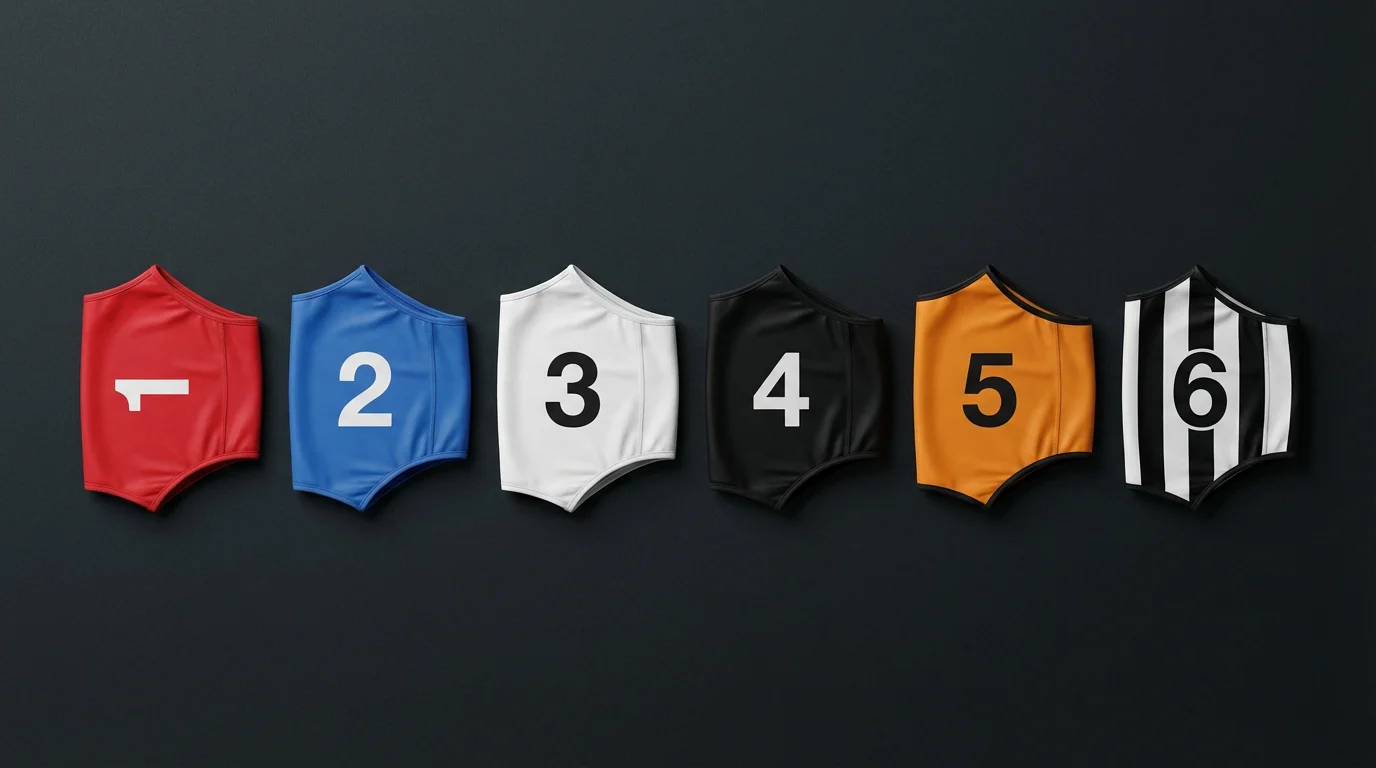
More Than a Fashion Statement
Every greyhound that walks to the traps wears a racing jacket, and that jacket isn’t decorative. The colour identifies which trap the dog starts from, and in a sport where six dogs cover 480 metres in under thirty seconds, being able to tell them apart at speed is not a luxury — it’s essential. For the judge calling the finishing order, for the commentator following the field, and for you watching on a screen or from the stands, the trap jacket is the visual anchor of the entire race.
The colour system is standardised across all GBGB-licensed tracks in England and Wales. It doesn’t change between venues, between grades, or between daytime and evening racing. Once you know the six colours, you know them everywhere. That consistency makes greyhound racing one of the easiest sports to follow visually — provided you’ve taken five minutes to learn the code.
But the colours carry more than identification. Because trap number determines starting position, and starting position influences the entire shape of the race, the jacket colour becomes a shorthand for something deeper: the dog’s expected running line, its draw advantage or disadvantage, and the kind of race it’s likely to encounter in the first four seconds after the lids fly open.
Apply trap knowledge when reading the racecard in read greyhound racecard.
The Six Trap Colours
The six greyhound trap colours in the UK follow a fixed sequence that has been standard for decades. Trap 1 is red. Trap 2 is blue. Trap 3 is white. Trap 4 is black. Trap 5 is orange. Trap 6 is black and white stripes.
Trap 1 — red — is the innermost starting position, closest to the inside rail. The dog in the red jacket has the shortest path to the first bend, which is the most tactically significant piece of track geometry in greyhound racing. A railer drawn in trap 1 can break, hug the rail immediately, and take the tightest line through every turn. At tight-bending tracks like Romford, this advantage alone produces a measurable statistical edge over any other trap.
Trap 2 — blue — is the second position from the inside. It’s still an inside draw, and at most tracks dogs in trap 2 are seeded as railers alongside trap 1. The blue jacket has nearly as good access to the rail, though the dog may need to take a stride or two to tuck in behind or alongside the red. On tracks with a long run to the first bend, the difference between traps 1 and 2 is marginal. On tracks with a short run, it can be decisive.
Trap 3 — white — occupies the middle-inside position. In seeded graded races, trap 3 can house either a railer or a middle runner, depending on the composition of the field. The white jacket sits at the boundary between inside and middle, and the dog wearing it often faces a choice: try to rail and risk getting squeezed, or settle for a middle path. How well a dog handles that ambiguity depends on its running style, and that information is available on the racecard’s seeding designation.
Trap 4 — black — mirrors trap 3 on the outside half of the boxes. It’s a middle draw, and dogs here are typically seeded as middle runners. The black jacket often finds itself in the busiest part of the track at the first bend — too far from the rail to tuck in cheaply, too far from the outside to swing wide without interference from the dogs in traps 5 and 6. At tracks where the first bend arrives early, trap 4 is widely considered the worst draw in graded racing.
Trap 5 — orange — is the outside-middle position. Dogs here are usually classified as wide runners or occasionally middle runners with a tendency to drift outward. The orange jacket has room to manoeuvre on the outside but pays for it in extra ground through every bend. The cost of that extra ground depends on the track: at wide, galloping tracks, it’s tolerable; at tight circuits, it’s often prohibitive.
Trap 6 — black and white stripes — is the widest starting position. The striped jacket is the farthest from the rail and from the hare rail. A dog in trap 6 must either possess exceptional early pace to cross the field and reach the rail before the bend, or accept a wide running line and rely on raw speed to compensate for the additional distance covered. In open races with random draws, trap 6 is the position most likely to produce an upset — a confirmed railer drawn out of position, forced to navigate terrain it’s not built for.
How Traps Relate to Seeding
The trap number is not a random assignment — at least not in graded races. The racing manager at each track allocates dogs to traps based on their assessed running style, following GBGB Rules of Racing. Dogs classified as railers go into traps 1 and 2. Middle runners go into traps 3 and 4. Wide runners go into traps 5 and 6. The seeding designation — unmarked for railers, “m” for middles, “w” for wides — appears on the racecard alongside the dog’s name.
This means that the trap colour carries an implicit message about how the dog is expected to run. Red and blue jackets should, in theory, indicate rail-seeking dogs. Orange and stripes should indicate dogs comfortable running wide. White and black sit in the transitional zone. When you see a race through the lens of trap colours, you’re seeing the racing manager’s best assessment of how each dog will navigate the track.
The system breaks down in open races, where traps are drawn randomly. A railer might be drawn in trap 6, forced into a wide berth that contradicts its natural instincts. A wide runner could land trap 1, where it either rails uncomfortably or drifts outward and causes crowding for the dogs beside it. These mismatches are where betting opportunities emerge — and where trap colours become particularly informative, because the jacket tells you the trap, the racecard tells you the running style, and the discrepancy between the two tells you the story of the race before it’s run.
Knowing the seeding convention lets you watch any race and immediately parse the tactical picture. Red and blue converging on the rail? Normal. Orange cutting inside? Something’s wrong — or something’s very right for that dog. The colours are the first layer of race-reading, and they’re visible the moment the dogs parade.
Trap Colour as Visual Identification During Racing
During a live race, trap colours are the only reliable way to follow individual dogs. Commentary helps, but the commentary is often a beat behind the action — by the time the caller says “the orange jacket is challenging,” you’ve already seen it happen if you know what to look for. And on a screen, especially on a bookmaker’s stream where the resolution isn’t always crisp, the jacket colour is more identifiable than the dog itself.
The distinction between white and black can be tricky under artificial lighting. Both appear as dark or pale shapes depending on the camera angle and the floodlight conditions. The stripes on the trap 6 jacket are usually the most distinctive visual marker in any race, which is one reason why wide runners in trap 6 are oddly easy to follow — you can track their progress around the outside of the field even when the pack is tightly bunched.
Red and orange are the two warmest colours in the set, and they stand out against the sand track surface more effectively than blue, white, or black. This visual salience is not accidental. The trap 1 and trap 5 jackets represent the inside and outside markers of the field — the extremes of the draw — and their brightness ensures that judges and cameras can track the widest points of the running pack at all times.
For bettors watching on screen, a useful habit is to identify your selection’s jacket colour before the race starts and focus on tracking that colour through the first bend. The first bend is where most races are decided, and knowing your dog’s jacket colour lets you assess in real time whether it got a clear run, got crowded, or got caught wide — information that feeds directly into your form assessment for its next outing.
Colour Code Memory Trick
Most punters learn the trap colours within a few meetings without any conscious effort — they just absorb them from repetition. But if you want to lock them in from the start, the sequence has a rhythm: red, blue, white, black, orange, stripes. Some people remember it as “Really Brave Women Buy Odd Socks.” The mnemonic is silly. It works.
The deeper value isn’t in memorising colours but in reading them as information. When you look at a racecard and see a dog in trap 1, you should immediately think: inside draw, likely railer, shortest path to the bend, red jacket. When you see trap 6, you should think: widest draw, probably a wide runner, longest path, stripes. The colour is the visible expression of an invisible tactical assignment, and once that connection is automatic, you’re reading races faster than most people in the grandstand — or on the sofa.
Six dogs. Six colours. Six stories. The jackets are just the opening line.
Learn about trap colours and numbers on the greyhoundcardstoday homepage.
