Greyhound Split Times Explained — Reading Sectionals
 Available in US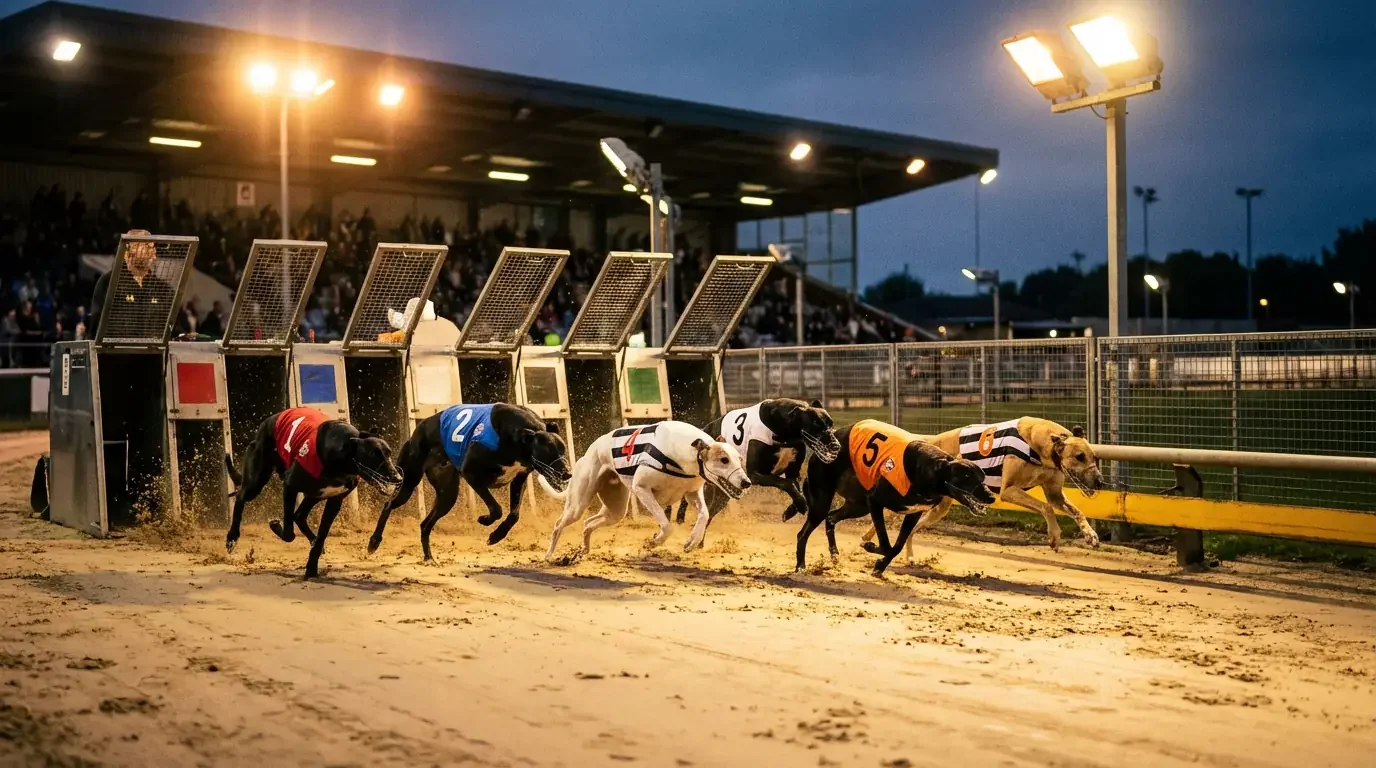
The Stat Most Punters Ignore
Greyhound punters love finishing times. They compare them, rank dogs by them, and use them to argue about which animal is fastest. But finishing time is the least useful number on the racecard for predicting what happens next. It tells you who won and how fast the race was — after the fact. It says nothing about how the race unfolded, where the decisive moments occurred, or which dog was actually running at the highest level of performance relative to its position on the track.
Split times do. The split — sometimes called the sectional time — captures the opening phase of the race: the time from the traps opening to the first passing of the finish line (or a designated timing point). That window of roughly three to five seconds, depending on distance and track layout, contains more predictive information than any other number on the card. It tells you how fast the dog broke, how quickly it reached racing speed, and — by implication — where it was positioned when the field hit the first bend. Since the first bend is where most greyhound races are decided, the split time is more predictive than any other figure on the card.
And yet most punters skip it entirely. They scroll past the split column, focus on the finishing position and the overall time, and miss the single most actionable data point available to them.
Apply split times to your speed theory in speed and first bend theory.
What Split Times Measure
The split time measures the period from the traps opening to the dog crossing a fixed timing point, which at most UK tracks is the finish line on the first pass. On a standard 480-metre oval, the dogs break from the traps, accelerate down the straight, and cross the finish line before entering the first bend. The time it takes to cover that initial section — typically somewhere between 3.5 and 5.5 seconds depending on the distance from traps to the line — is the split.
What makes this number valuable is what it reveals about early pace. A dog that consistently posts the fastest split in its races is a natural front-runner. It reaches racing speed quickly, gets to the bend first, and dictates the shape of the race. A dog with a moderate split but strong finishing time is a closer — it runs on at the end rather than burning energy early. Both are useful profiles, but for different reasons and in different race types.
The split is expressed in seconds and hundredths. You’ll see figures like 3.82, 4.15, 5.21 depending on the track and distance. The absolute number varies between venues because the distance from traps to the timing point differs — a 280-metre sprint at Romford produces a very different split to a 480-metre standard race at Monmore. What matters is not the raw number but how it compares to the other dogs’ splits in the same race, at the same track, over the same distance.
On data platforms like Timeform, you can find historical split averages for each trap position at each track. These baselines let you assess whether a dog’s split was fast, average, or slow relative to where it started. A 3.85-second split from trap 1 might be average at a particular track, while the same 3.85 from trap 6 might be exceptional — because the trap 6 dog had to cover more ground to reach the timing point. Without that baseline context, split comparisons are misleading.
Comparing Splits Across Traps
Comparing split times across different trap positions is the single most underused skill in greyhound form analysis. The reason most punters don’t do it is that it requires an extra step of thinking — you can’t just line up six numbers and pick the smallest one. You need to account for the geometry of the starting position.
A dog in trap 1 starts on the rail and runs the shortest possible path to the timing point. A dog in trap 6 starts several metres wider and must either angle inward or run a wider line, both of which add distance. The time difference caused by trap position alone — not speed, not ability, just geometry — can be anywhere from 0.05 to 0.15 seconds depending on the track layout. That sounds negligible until you realise that the gap between the fastest and slowest split in a competitive A4 race is often less than 0.30 seconds. Geometry accounts for a significant portion of the apparent difference.
The practical adjustment is straightforward. When comparing splits, mentally add a small allowance to the inside traps or subtract from the outside traps. Some serious form students maintain a personal adjustment table for the tracks they bet on regularly, derived from hundreds of historical splits by trap position. Others use the simpler rule of thumb: a trap 6 dog posting the same split as a trap 1 dog is the faster animal, and a trap 1 dog that posts only marginally quicker than a trap 6 runner is not as quick as the raw numbers suggest.
This adjustment becomes crucial when assessing dogs that switch traps between races. A dog that posted a split of 3.90 from trap 2 last week and is now drawn in trap 5 should not be expected to replicate that figure. The wider draw adds ground. If the dog posts 4.02 from trap 5, that may represent the same or even superior early pace, once the geometry is stripped out. The punter who reads 4.02 and dismisses the dog as slower is reading the data incorrectly.
Similarly, beware of dogs whose impressive splits were recorded exclusively from trap 1 or trap 2. Those dogs may have benefited from the shortest path and never been tested from a wider berth. When they draw 4, 5, or 6, the split will lengthen — and if their entire competitive edge was early position rather than raw speed, the form collapses.
Using Splits to Predict First-Bend Position
The primary reason split times matter is that they predict first-bend position, and first-bend position predicts race outcomes. Study after study of UK greyhound racing data — and the observable pattern at any track you watch regularly — confirms the same finding: the dog that leads at the first bend wins more often than any other dog in the field, regardless of grade, distance, or track.
The chain of logic runs cleanly. A fast split means the dog reaches the bend first or near the front. Reaching the bend first means clear running through the turn. Clear running through the turn means the dog maintains racing speed without interference. And maintaining speed without interference, over four bends on a standard oval, compounds into a significant advantage by the finish.
The racecard tells you each dog’s split from recent runs. Line those splits up against today’s trap draw and you can build a first-bend picture before the race happens. If the fastest splitter is drawn in trap 1, the advantage doubles — fast pace plus the shortest route. If the fastest splitter is drawn in trap 6, the advantage is compromised — fast pace but the longest path. The second scenario is where value often hides: the market may still price the trap 6 dog as a front-runner, but the geometry means it’s less likely to lead at the bend, and a dog from a lower trap with a marginally slower split may get there first simply by taking the shorter line.
Forecasting first-bend position from splits and draw is the closest thing greyhound betting has to a repeatable, data-driven method. It won’t be right every time — dogs can break poorly, bump coming out of the boxes, or show unexpectedly sharp early pace on a given day. But over fifty or a hundred races, the punter who builds a first-bend model from split data will outperform the punter who picks by name, colour, or gut feeling.
The Four-Second Window
Greyhound races are decided in a window of about four seconds. The traps open, six dogs accelerate from zero to roughly 40 mph, the field converges on a single bend, and the order is largely established. Everything after that — the back straight, bends two, three and four, the final run-in — is mostly a function of what happened in those opening moments. Dogs swap positions in the closing stages, of course, but the dog that gets clear air through the first two bends holds its advantage far more often than it loses it.
That four-second window is what the split time captures. It’s compressed, it’s noisy — a slow break from the traps can cost two lengths that have nothing to do with a dog’s true pace — and it’s imperfect. But it is, on balance, the most predictive number the racecard gives you. Learn to read it properly — adjusted for trap, compared to track averages, projected into today’s draw — and you have an edge that most of your competitors at the betting window haven’t bothered to develop.
The finishing time tells you who won the last race. The split tells you who’s going to win the next one.
Understand split times on the greyhoundcardstoday homepage.
